
Creator Wallets Compared: Paxum vs CosmoPayment vs Capitalist
Paxum, CosmoPayment and Capitalist are three of the most common wallets in the creator economy. Here is how they compare in 2026 on fees, KYC, payout rails and crypto — and why none of them solves the problem an agency actually has.
Creator Wallets Compared: Paxum vs CosmoPayment vs Capitalist
For an individual creator receiving platform payouts, a wallet is usually the first financial tool that works without an argument — somewhere adult-friendly to receive money, hold a balance, and spend it on a card. Three names come up again and again in Europe: Paxum, CosmoPayment, and Capitalist.
This independent comparison looks at what each one actually offers as of July 2026 — regulation, fees, KYC, payout rails, cards, and crypto — and then asks the question that matters for anyone running a fans agency rather than a solo account: do any of them handle splitting money between an agency and its creators? The short answer shapes everything below.
What a "Creator Wallet" Is — and Isn't
All three services are, at heart, individual wallets. Money comes in, sits in a balance, and goes out — by transfer or card. They earned their place in the creator economy by serving adult and high-risk users that mainstream providers turn away, and by doing it reliably for years. That is a genuine achievement, and nothing in this article should be read as a knock against it.
What they were never designed to do is operate as multi-party infrastructure. A wallet has one owner; an agency has a roster. That distinction — wallet versus agency-grade solution — is the thread running through this comparison.
Paxum: The Veteran
Paxum has operated in the adult payment space since 2007, run by Paxum Bank Limited, registered in the Commonwealth of Dominica — licensed there, but not regulated within the EU. It offers personal and business accounts, transfers between Paxum users, wire and EFT payouts reaching 50-plus countries, and a UnionPay International prepaid card. An IBAN is available for incoming SEPA and wire transfers in euro, but the account itself is USD-based and fees are charged in dollars.
The published fee schedule gives a fair picture of where the costs sit. The account carries a monthly fee of $5 on the payments side. Internal Paxum-to-Paxum transfers are cheap — one reason platforms and studios have used it for payouts for nearly two decades — and moving money onto the prepaid card costs $0.25. Getting money out to a bank is where it adds up: a wire to your own account costs $40 in EUR or $50 in USD, and wires to third parties run 0.5–1% with a $50 minimum. A creator who spends mostly on the card rarely feels those wire fees. Anyone regularly pushing balances out to a European bank account feels them every month.
Paxum's real moat is coverage. Over 5,000 companies pay out through it, and nearly every adult platform, cam site, and clip store that matters lists it as a payout option — often the first one they added. For creators on smaller or older platforms, Paxum is sometimes the only wallet on the payout menu, which settles the comparison before it starts.
KYC is conventional: identity document, proof of address issued within the last three months, and a confirmed phone number before the card ships. Where Paxum shows its non-EU character is the card network — UnionPay rather than Visa or Mastercard, with noticeably thinner acceptance across European shops and ATMs — and the dollar-denominated fee schedule, which quietly adds FX cost to a business that earns and spends in euro. We cover the full picture in our Paxum review.
CosmoPayment: The European-Facing One
CosmoPayment is a European-facing e-money service built around a mobile account and payment cards. It issues virtual and physical Visa cards and supports bank-transfer rails including SEPA in supported European countries, SWIFT, and Faster Payments in the UK — a genuinely more European footprint than Paxum's USD-and-UnionPay setup, and cards on a network that actually works everywhere on the continent.
Its fee page is worth reading closely, because the costs are transaction-shaped rather than subscription-shaped. Foreign or non-USD transactions can carry charges of up to 3.5% above network rates, ATM withdrawals outside the EU add 1%, and same-currency bank transfers can incur up to 2%. Card loading is capped: roughly $6,000 per day, $20,000–25,000 per 30 days, and $80,000–90,000 per year depending on card type. New accounts also face graduated onboarding limits — capped daily and monthly spend in the first months after verification.
Two further things are worth knowing. The cards work wherever Visa is accepted but exclude crypto exchanges and money-transfer sites. And those loading ceilings, generous for one creator, are tight for pooled volume: an agency trying to route €40,000–50,000 a month through a single account runs straight into them. Like the others here, CosmoPayment is built for an individual account holder, not for distributing money across a roster.
Capitalist: Multi-Currency Plus Crypto
Capitalist, launched in 2011, is the most feature-dense of the three. It holds multi-currency balances (USD, EUR, RUB) alongside major cryptocurrencies — BTC, ETH, USDC, and USDT on both TRC-20 and ERC-20 — issues virtual and physical Visa and Mastercard cards, and offers free transfers between Capitalist users. Deposits via SEPA and SWIFT are free; withdrawals to bank accounts and cards start at around 2% per its published tariffs. Bank rails unlock after verification.
It also has a notable compliance characteristic: parts of the system are usable in a low-verification status. For an individual that reads as convenience. For an agency it is the opposite, and 2026 has sharpened the point considerably. MiCA's transitional period ended across the EU on 1 July 2026 — any crypto-asset service provider without a full MiCA licence must now cease EU operations, and only around 220 licences have been issued from roughly 3,500 pre-MiCA registrations. At the same time, DAC8 has required crypto-asset service providers to collect transaction data on all EU-resident users since 1 January 2026. Before relying on any wallet's crypto rails for EU business, verify its current licensing status — and read our guide to MiCA and crypto payouts for what changed on July 1.
KYC and Onboarding: Three Philosophies
The three wallets take visibly different approaches to verification. Paxum requires full KYC before meaningful use: documents, address, phone, and corporate paperwork for business accounts. CosmoPayment verifies you and then loosens limits gradually over the first months. Capitalist lets you start light and deepen verification as you add bank rails.
For a solo creator, these differences are mostly about convenience. For an agency, they are compliance posture. Under DAC7, platforms have reported creator earnings to EU tax authorities since 2024 — authorities now hold more than two years of income data and actively cross-check it. DAC8 extends the same reporting to crypto. Money that arrives from a platform into a wallet and then disperses as internal P2P transfers or crypto hops no longer matches what the tax office can already see, and mismatches are what trigger questions. Traceable, well-documented rails are not a bureaucratic nicety; they are how platform-reported numbers reconcile with your bank statements. Our guides to DAC7 and AMLA cover the regulatory backdrop in detail.
Payout Rails at a Glance
| Paxum | CosmoPayment | Capitalist | |
|---|---|---|---|
| Regulation | Dominica (non-EU) | EU e-money framework | E-wallet |
| Base currency | USD | Multi-currency | USD / EUR / RUB + crypto |
| SEPA | Incoming via IBAN | Yes | After verification |
| SWIFT | Yes | Yes | After verification |
| Card | UnionPay prepaid | Visa | Visa / Mastercard |
| Crypto | No | No (blocked at crypto merchants) | BTC, ETH, USDT, USDC |
| Automated splits | No | No | No |
Which Wallet Fits Which Creator
For a solo creator, the choice usually resolves along three lines. If your platforms pay to Paxum and you spend mostly on card, Paxum's track record and cheap internal transfers outweigh the UnionPay acceptance gap and dollar-based fees. If you live and spend in Europe and want a card that works at every terminal, CosmoPayment's Visa cards and SEPA support make it the more natural home — as long as your volume sits comfortably inside its loading limits. If you hold multiple currencies or take part of your income in crypto, Capitalist is the only one of the three that handles it, with the MiCA caveat above.
None of these is a wrong answer for an individual. The wrong answer only appears when an agency tries to stretch one of them across a roster.
The Common Thread: No Automated Splits
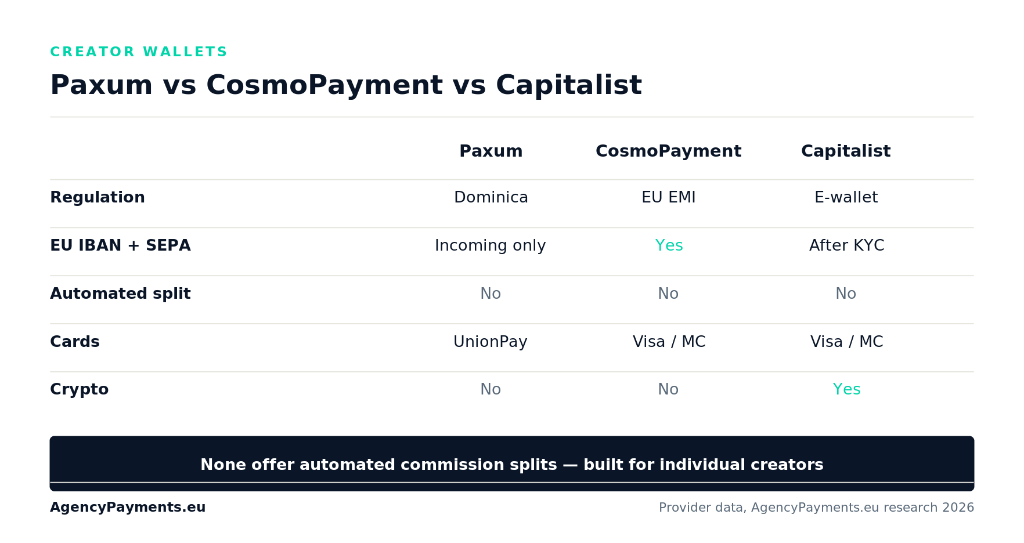
For all their differences, the three wallets share the defining limitation for agencies: none of them automatically splits an incoming payment between an agency and its creators. They are designed for one person receiving and spending their own money.
That is not a criticism — it is what a creator wallet is. For a solo creator, any of the three can be a perfectly reasonable choice, and the right pick depends on whether you prioritise European card acceptance (CosmoPayment), crypto and multi-currency flexibility (Capitalist), or a long adult-friendly track record and platform coverage (Paxum).
An agency managing five, twenty, or fifty creators has a different job entirely: every incoming payout has to be divided by a pre-agreed percentage and forwarded to the right person, every cycle. A wallet pushes that work back onto your staff.
When an Agency Outgrows a Wallet
Here is what manual commission collection looks like in practice. Twenty creators paid weekly means eighty-plus calculations a month, each one an opportunity for error. Agencies running on wallets typically end up with one of two workarounds, and both age badly. Either creators receive their full payout and forward the agency's commission — which turns your finance function into a chasing operation — or the agency controls the wallets and pays creators their share, which concentrates custody risk, strains trust, and routes everyone's money through accounts designed for one individual.
The moment you are calculating and sending individual transfers by hand each payout cycle, you have outgrown the wallet category. The cost shows up as staff time, payment delays, and errors — and it grows with every creator you add. Wallet fees compound the same way: wire charges, FX spreads on dollar-based accounts, and per-transfer costs that are trivial for one person become a measurable line item across fifty payouts a month. We trace how that operational load evolves in scaling payment operations from 5 to 50 creators.
Agency-grade payment solutions close that gap by automating the split at the moment funds arrive, dividing each payment between the agency account and each creator's account by a configured percentage. Several are EU-licensed Electronic Money Institutions, which also brings EU IBANs, SEPA, and the regulatory standing that wallets registered outside the EU can't offer. We compare the leading options in our agency-grade provider comparison and walk through the selection criteria in how to choose a payment provider for your fans agency.
Bottom Line
Paxum, CosmoPayment, and Capitalist each do a solid job at what they were built for: giving an individual creator an adult-friendly place to receive, hold, and spend money. They differ on cards (UnionPay vs Visa), currencies (USD-centric vs multi-currency), crypto (only Capitalist), and regulatory footing — but they converge on the same limit. None of them was designed to run an agency's payouts, and none of them splits money automatically.
For a solo creator, pick the wallet whose strengths match your needs — the fee schedules linked above are the right place to start. For a fans agency, the comparison that actually matters isn't between these three. It's between a wallet and agency-grade infrastructure.
Use our free comparison calculator to see how wallet-style and agency-grade options compare for your volume and commission structure.
AgencyPayments.eu is an independent informational resource. We are not affiliated with Paxum, CosmoPayment, Capitalist, or any other provider mentioned. Details are sourced from publicly available information, current as of July 2026, and may change.

