
AMLA 2025: What the New EU Anti-Money Laundering Rules Mean for European Fans Agencies
The EU's new anti-money laundering framework - built around AMLA, the AMLR, and the 6AMLD - is reshaping how European fans agencies manage compliance. Here is what changed and what your agency needs in place for 2026.
The EU anti-money laundering framework has been overhauled. The new package - built around the Anti-Money Laundering Regulation (AMLR), the 6th Anti-Money Laundering Directive (6AMLD), and the establishment of the Anti-Money Laundering Authority (AMLA) - represents the most significant reform of AML rules in the EU in a decade.
For European fans agencies, the timing matters. You operate in a sector that financial regulators classify as elevated risk. Understanding what changed, why it affects you, and what compliant infrastructure looks like is becoming a baseline requirement for running a legitimate European business.
What AMLA Is and Why It Was Created
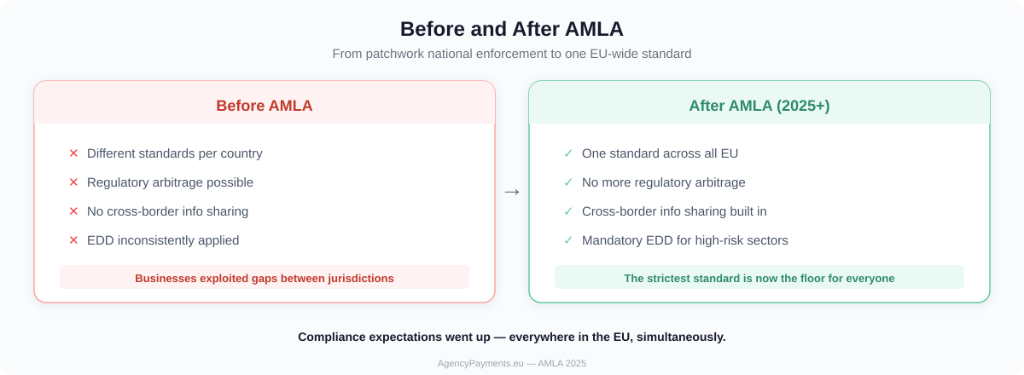
AMLA - the Anti-Money Laundering Authority - is a new EU supervisory body established in 2024, with operational activity accelerating through 2025. Its mandate is to harmonise AML enforcement across EU member states and end the patchwork of national implementations that allowed criminals to exploit regulatory arbitrage between jurisdictions.
Before AMLA, AML enforcement depended entirely on national supervisors - the quality of which varied significantly. A business operating across multiple EU countries could face very different compliance expectations depending on where regulators happened to be stricter. AMLA ends that inconsistency.
The practical implication: the compliance standard that previously applied only in the strictest EU jurisdictions now becomes the floor for the entire EU. If your payment provider, your business account provider, or your clients' financial institutions are regulated in the EU, they now operate under the same standards - and they will pass those expectations on to you.
What the New Rules Actually Changed
The new EU AML package introduces several changes that directly affect how financial institutions deal with businesses in high-risk sectors.
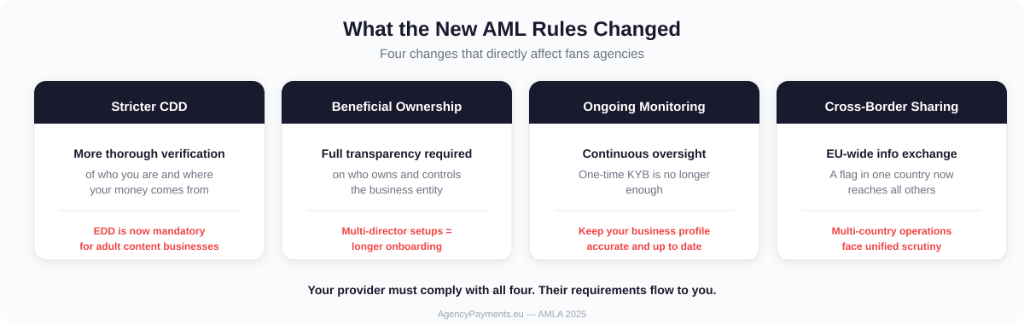
Stricter CDD requirements. Customer Due Diligence - the process by which your payment provider verifies who you are, what your business does, and where your money comes from - is now more thorough. For businesses in sectors deemed elevated risk (which includes adult content-related businesses in most EU risk frameworks), Enhanced Due Diligence (EDD) is no longer optional. It is mandatory.
Expanded beneficial ownership requirements. Any business opening accounts with regulated EU financial institutions must now provide transparent documentation of who ultimately owns and controls the entity. For fans agency owners operating through holding structures or multi-director setups, expect more questions, more documentation, and longer onboarding timelines.
Ongoing monitoring requirements. It is no longer sufficient to pass a one-time KYB check and then operate unchecked. Licensed payment institutions under AMLA-aligned rules are now required to monitor transactions on an ongoing basis and flag patterns that are inconsistent with the declared business profile. For agencies with variable income, multiple-currency flows, or high transaction volumes, this means keeping your declared business profile accurate and up to date.
Cross-border cooperation. AMLA creates new frameworks for information sharing between national AML authorities. A flag raised in one EU country can now much more easily reach a regulator in another. If your business operates across multiple EU jurisdictions - which most European fans agencies effectively do, given where their models and clients are located - this is a material change.
Why Fans Agencies Are in the Regulatory Spotlight
The adult content industry has always attracted elevated regulatory scrutiny. Financial regulators include it in risk classifications for a straightforward reason: high cash flows, international transactions, complex principal-agent relationships, and historically variable compliance practices.
The DAC7 reporting requirements that came into effect in 2024 already pulled fans agencies directly into the formal tax reporting framework. AMLA adds AML requirements on top. The combination means that agencies which relied on informal, undocumented payment flows now face scrutiny from two directions simultaneously: tax authorities receiving DAC7 data, and AML supervisors reviewing transaction patterns.
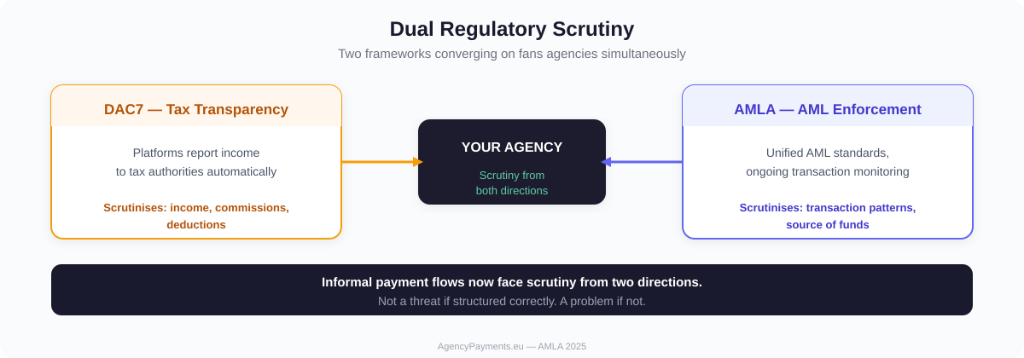
This is not a threat if your operations are structured correctly. It is a problem if they are not.
The specific risk factors that regulators focus on in the adult content sector include: cash-like payment instruments, high transaction frequency, international remittance patterns, complex agency structures, and gaps between declared income and transactional activity. Each of these is addressable through proper financial infrastructure.
What Compliant Infrastructure Looks Like for a Fans Agency in 2026
Understanding the regulatory context is the first step. The practical question is: what does your business actually need in place to operate compliantly under AMLA-aligned rules?
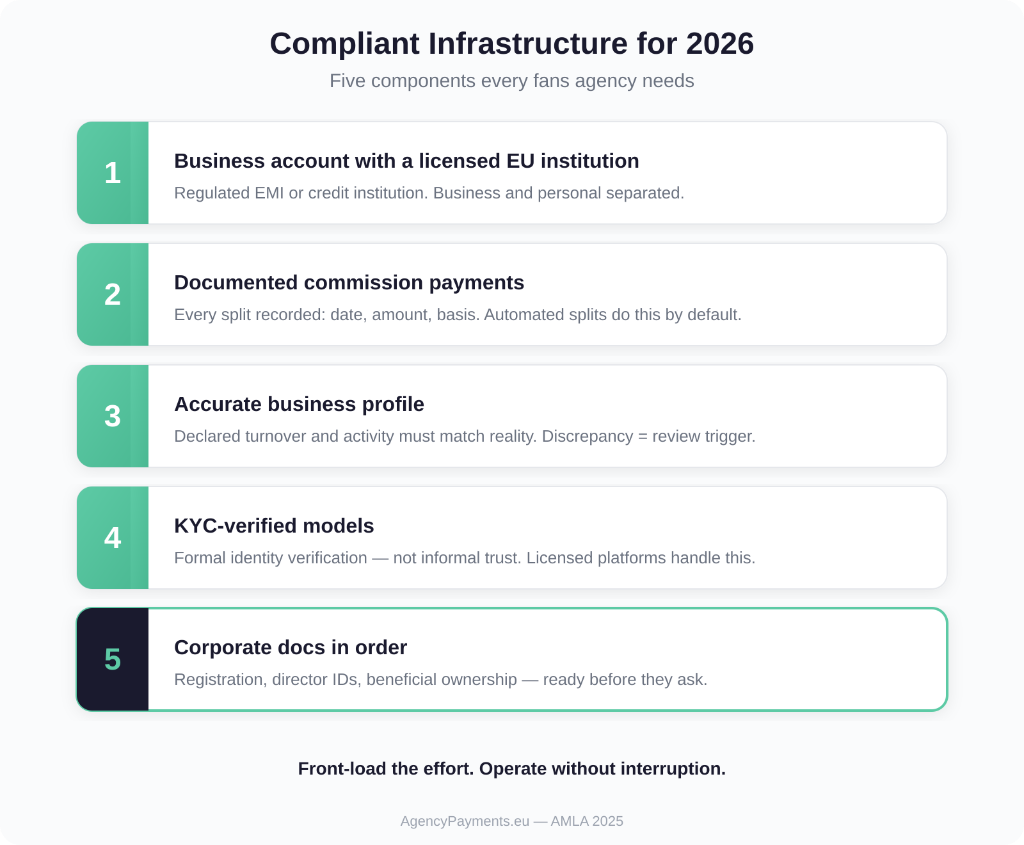
A business account with a licensed EU institution. Your agency's income should flow through a business account held with a regulated European Electronic Money Institution (EMI) or credit institution. The regulator and your payment provider both need to see a clear, documented separation between your business finances and your personal finances.
Transparent commission documentation. Every commission payment you receive from a model's payout should be documented - with a clear record of date, amount, and the basis for the calculation. Automated split payments achieve this as a function of how the mechanism works: every split is recorded by the payment provider, with both parties receiving transaction confirmation.
Accurate business profile declarations. Your declared business activities, turnover range, and transaction patterns should reflect what is actually happening in your accounts. If your volume grows significantly, update your profile with your payment provider. Discrepancies between declared and actual activity are a primary trigger for account reviews.
KYC-compliant model onboarding. The models you work with should have verified identities - through a formal KYC process, not informal trust. When your payment provider asks about your models, you need to be able to confirm that they are verified. A split payment infrastructure built on a licensed platform handles this automatically during model registration.
Corporate documentation in order. If your agency is a limited company, ensure your company registration, director documents, and beneficial ownership structure are current and accessible. AMLA-aligned EDD requests can come with short notice. Having documentation ready reduces onboarding friction and account review delays.
The EDD Process in Practice
Enhanced Due Diligence - the additional layer of verification required for higher-risk business categories - is now a standard part of onboarding with EU-regulated financial institutions for fans agencies.
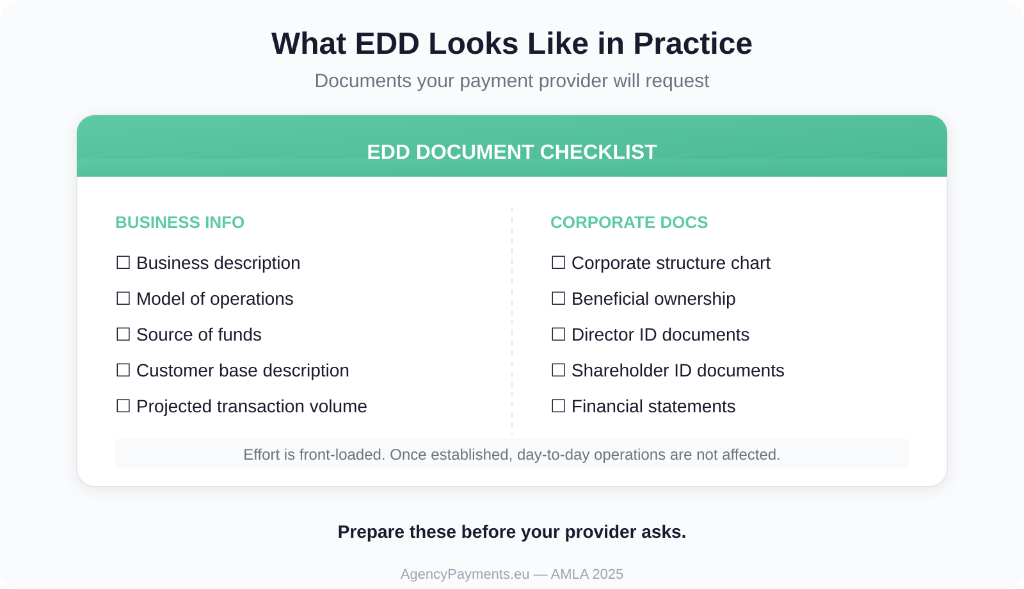
What does this typically involve? EDD requests vary by institution, but a standard EDD process for an adult content agency includes: detailed business description and model of operations, source of funds documentation, corporate structure and beneficial ownership chart, identification documents for all directors and significant shareholders, recent financial statements or projected transaction volume, and a description of the customer base.
Some institutions also require ongoing periodic reviews - typically annually or when transaction patterns change materially.
This may seem demanding. But from the regulator's perspective, a business that can answer these questions clearly and quickly is a low-risk business. The effort is front-loaded at onboarding. Once your account is established and your transaction profile is consistent with your declaration, day-to-day operations are not affected.
Questions Fans Agency Owners Ask About AML Compliance
Does AMLA affect my business directly, or only my payment providers? AMLA is an EU-level supervisory authority. It directly supervises the largest obliged entities and sets standards for national supervisors. Your payment providers and any licensed financial institution you work with are obliged entities. They must comply - and their compliance requirements flow to you as their customer.
I operate as a sole trader, not a company. Do these rules still apply? Yes. AML and KYC obligations apply to natural persons as well as legal entities. A sole trader operating a fans agency is still subject to identification requirements, source of funds questions, and EDD if the risk profile warrants it.
My payment provider has not asked me for EDD documents. Does that mean I'm fine? Not necessarily. Requirements are being phased in, and different institutions are at different stages of implementing AMLA-aligned standards. It is better to proactively ensure your documentation is in order than to wait for a request that may come with a tight deadline.
Can my agency be refused service by EU payment providers purely because of the industry? Yes, this remains possible. Being in the adult content sector does not automatically disqualify you, but some institutions decline the sector entirely. Working with a payment provider that has explicit experience in and compliance frameworks for the adult content sector eliminates this risk entirely.
What This Means for How You Choose a Payment Provider
The AMLA framework does not just affect your business operations - it affects which payment providers you can effectively work with.
A payment provider that has not built compliance infrastructure for the adult content sector will either decline your business at onboarding or freeze your account when transaction monitoring flags content platform transfers. This was true before AMLA. It is more true now.
The providers that work well for European fans agencies under the new framework are those that: hold EU EMI licences with national supervisors who are AMLA-aligned, have built sector-specific EDD frameworks for adult content businesses, offer automated split payment infrastructure that creates the transaction documentation the regulator expects, and have operated in the sector long enough to have worked through compliance edge cases with their supervisors.
The practical advice is straightforward: choose your payment provider the way you would choose any regulated business partner. Verify the licence. Ask about sector experience. Understand the fee structure. Get the compliance requirements in writing.
The agencies that approach AMLA as a framework to understand and work within - rather than an obstacle to avoid - will find that compliant operations create a competitive advantage. They can demonstrate regulatory standing to platforms, partners, and future banking relationships. They can scale without worrying about account disruption. And they can approach the ongoing regulatory evolution from a position of strength rather than scramble.

