AI Chatbots in Fans Agency Operations: Scaling, Compliance, and What’s at Stake in 2026
Elena runs a 30-model agency in Madrid and spends €8,000/month on chatters. She’s seen the demos promising 90% automation. This guide gives honest answers on OnlyFans TOS, EU AI Act Article 50, the real cost economics, and what happens to your chatter team — so you can decide how and whether to automate in 2026.
Elena runs a 30-model fans agency in Madrid. Her chatter team — twelve remote workers, mostly in the Philippines — costs roughly €8,000 a month and keeps inboxes warm twenty-four hours a day. Last week she sat through a Substy.ai demo that promised to automate ninety percent of that work. The math was tempting. The questions she could not stop asking were less so.
Will OnlyFans terminate her models if it detects automation? What does the EU AI Act actually require from her after August? And what happens to twelve people whose rent depends on a workflow she is about to dismantle?
This is an operational guide, not a product review. It walks through the three layers an agency owner has to weigh together when deciding how — and whether — to automate fan messaging in 2026: platform rules, regulatory disclosure, and the cost economics underneath both.
The 2026 automation spectrum
"AI chatbot" has become a catch-all term that obscures what these tools actually do. Three operational modes are now distinguishable, and the difference between them matters more than the brand on the dashboard.
Assistive AI sits inside a chatter's existing workflow as a productivity tool. It summarizes long DM threads, suggests upsells based on a fan's purchase history, drafts cold-message templates, and surfaces fans who haven't been engaged in seven days. The human types every reply. Adoption here is now near-universal in agencies above five models.
Co-pilot AI drafts a reply and presents it to a human chatter, who approves, edits, or rewrites before sending. Supercreator built its reputation on this pattern. The AI does the cognitive heavy lifting — remembering fan preferences, matching tone, structuring a sales funnel — but a person remains the last touch before any message lands in a fan's inbox.
Autonomous AI handles full conversations end-to-end, with no human in the per-message loop. Substy.ai and a small handful of competitors operate here. The chatbot remembers each fan, adapts to their tone and spending history, and executes the funnel from welcome message to pay-per-view sale without intervention. The performance numbers — automation of roughly ninety percent of inbox volume — are real. So is the regulatory exposure.
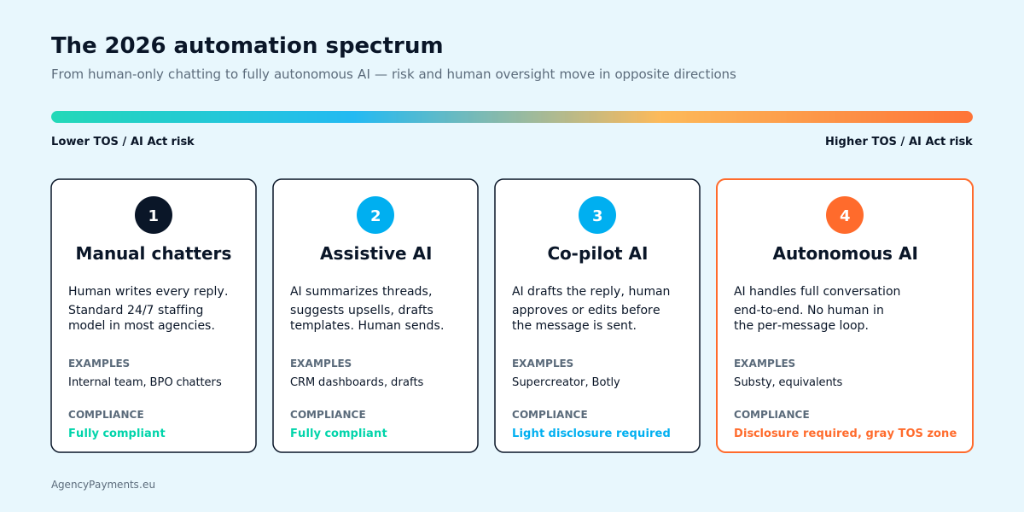
The three modes sit on a single spectrum, but the slope is not linear. Assistive and co-pilot tools live well within OnlyFans' authenticity rules and the EU's transparency obligations. Autonomous tools occupy the gray zone where current TOS language was clearly not written with this category in mind.
What OnlyFans TOS actually says — and what it doesn't
OnlyFans' platform terms prohibit fully automated bots that impersonate creators in direct messaging without human oversight. The 2026 policy refresh also requires that AI-generated visual content be clearly tagged with
#AI#AIGeneratedWhat the TOS does not do is define automation operationally. There is no clause specifying maximum AI involvement per message, no required disclosure pattern in chat, and no detection rubric agencies can engineer against. Enforcement, in practice, has been behavioral: accounts that exhibit superhuman response patterns (replies in under three seconds, twenty-four-hour activity, identical sentence structures across dozens of fans) draw scrutiny.
Co-pilot tools where AI suggests and a human approves are accepted across the board. Autonomous tools sit in a grayer zone that most operators acknowledge privately and few discuss publicly. They work today. Whether they work after the next enforcement cycle is a bet, not a certainty.
For agencies, the cost of being wrong is concrete: a TOS violation can cascade into model account suspension, frozen earnings during platform investigation, and potential payment-provider follow-on action when the merchant flag changes. We have written separately about why fans agencies get accounts frozen, and TOS-driven model termination is one of the documented triggers.
The EU AI Act layer most agencies are missing
Most public discussion of AI chatbots in this industry focuses on OnlyFans rules. The bigger 2026 development is regulatory, and it applies regardless of the platform: the European Union's AI Act enters its transparency-obligation phase on August 2, 2026.
Article 50 of the AI Act covers "limited-risk" AI systems, which is the category chatbots fall into. The core requirement: where users interact with an AI system, they must be informed that they are interacting with an AI, not a human, in a clear and timely manner. The obligation falls on the deployer — the entity operating the AI in a real-world context. For an agency running Substy or any equivalent autonomous tool, that deployer is the agency itself.
A second clause covers deepfakes and synthetic media: any image, audio, or video generated or substantively manipulated by AI must be labeled as such.
The tension specific to fans platforms is one Article 50 was not written with in mind. The persona itself is the product. A disclosure that says "you are talking to an AI" undermines the commercial premise. A disclosure that says nothing risks regulatory exposure.
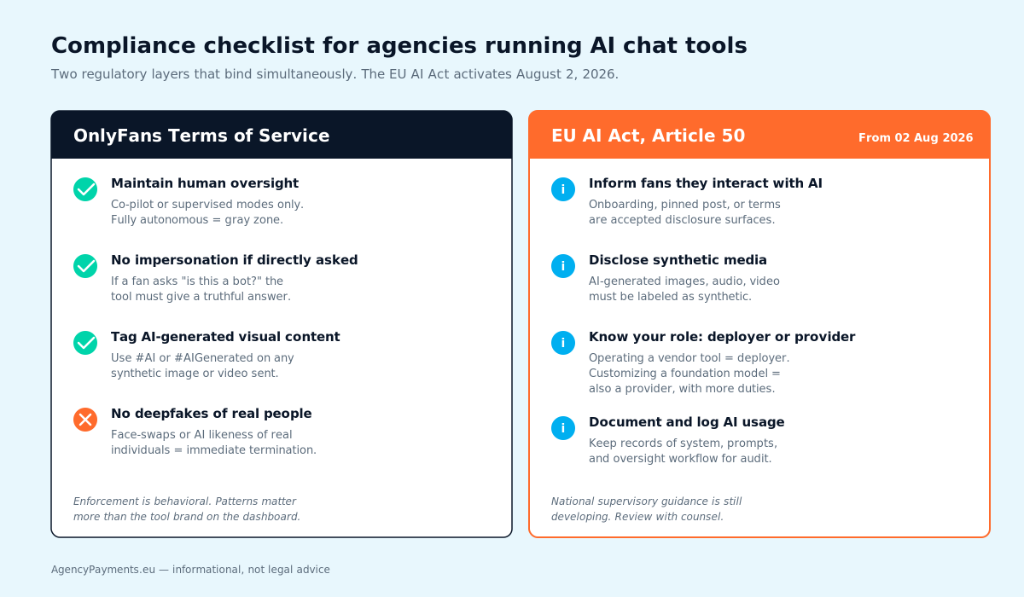
Practitioners are converging on a "human-supervised AI" disclosure pattern: language in onboarding flows or pinned posts noting that DM responses may be assisted or generated by AI under human supervision. This pattern arguably satisfies Article 50 without requiring per-message disclosures inside the chat itself.
August 2, 2026 is twelve weeks from publication of this article. Agencies running autonomous tools today have a finite window to design a disclosure posture before the obligation becomes enforceable.
The cost economics — at 10, 25, and 50 models
Chatter labor is the second-largest variable cost in most agency P&Ls after platform fees, and AI tools change the slope of that cost curve sharply.
Industry reporting places typical chatter pay in the Philippines and adjacent markets between $750 and $1,100 per month for full-time work. Twenty-four-hour coverage of a single high-earning model typically requires four to six chatters working overlapping shifts.
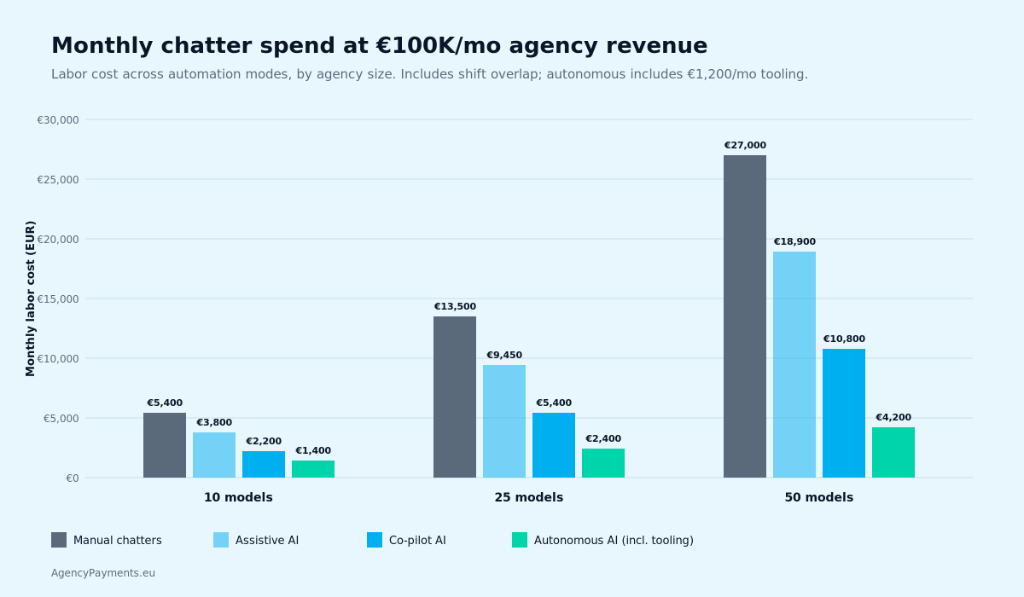
| Mode | 10 models | 25 models | 50 models |
|---|---|---|---|
| Manual chatters | €5,400 | €13,500 | €27,000 |
| Assistive AI | €3,800 | €9,450 | €18,900 |
| Co-pilot AI | €2,200 | €5,400 | €10,800 |
| Autonomous AI | €1,400 | €2,400 | €4,200 |
The savings curve is real. At fifty models, autonomous AI removes roughly €23,000 a month of labor cost relative to manual chatters.
The hidden costs are also real. Subscription tooling ranges from €500 to €1,500 a month. Prompt engineering — teaching the AI a model's voice, kink list, no-go list, pricing, and upsell triggers — consumes principal-level time during onboarding and ongoing maintenance.
The downstream effect on commission economics is underappreciated. An agency running €25,000 in monthly chatter cost may have priced itself at a 60% commission. Drop chatter cost to €8,000 and a 45% commission becomes viable — which expands negotiating leverage and changes which payment providers are eligible. Yoursafe's auto-split mechanic caps at 50% commission, so an agency moving from 60% to 45% becomes Yoursafe-eligible. Blackcat's tiered fee structure rewards higher volume more efficiently than a flat-rate provider.
What honest disclosure looks like
The question is not whether to disclose AI use — under Article 50, agencies operating autonomous tools have to. The question is how to disclose without dismantling the commercial premise of a fans platform subscription.
The pattern that appears to satisfy both the EU obligation and the platform's authenticity rules has three components. First, an onboarding-flow disclosure that DM responses may be generated or assisted by AI under human supervision. Second, the
#AI#AIGeneratedA decision framework
Whether automation makes sense for a given agency reduces to four operational questions.
Scale. Below ten models, a single experienced chatter will outperform any current AI on quality, and the AI tooling subscription cost dominates the labor savings. Above twenty-five models, the math reverses.
Commission structure. Agencies on rates above 50% have used the high take rate, in part, to fund chatter labor. Automation collapses that justification.
Model roster preferences. Some creators are vocal about wanting chats handled exclusively by humans. Co-pilot tools, framed as "we help your existing chatter work faster," meet less resistance than autonomous deployment.
Regulatory and TOS risk tolerance. An agency one TOS violation away from losing card processing access has a different math problem than an agency on a clean record.
The labor question
The cost numbers above describe a real shift in employment for several thousand people working as chatters across the Philippines, Nigeria, India, and Pakistan.
The agency response that has held up well follows a pattern. Existing chatters move from line-level message production into QA, prompt training, and edge-case handling. Headcount reductions are typically thirty to forty percent, not the headline ninety percent the marketing implies, because the QA and training functions absorb the rest. The agencies that handle this transition badly — sudden mass layoffs, no transition pathway — tend to face quality problems for the first six months as institutional knowledge walks out the door.
FAQ
Will OnlyFans ban my model's account if I use Substy or Botly? Co-pilot tools where a human approves each message are accepted in practice. Fully autonomous tools sit in a gray zone: enforcement to date has targeted detection-by-behavior rather than tool use per se. The risk is real but lower than the strict reading of the TOS would suggest.
Does the EU AI Act require me to put “I am an AI” inside chat replies? The Act requires users be informed in a clear and timely manner, but does not specify per-message disclosure. The pattern emerging in practice is onboarding-flow disclosure rather than mid-conversation watermarks. Final enforcement guidance is still developing; review with legal counsel before August 2, 2026.
What does AI chat with adult content mean for child-safety reporting? Adult-content platforms have mandatory reporting obligations to NCMEC if AI-generated material involves or could involve minors. This is a hard line. Agencies running autonomous AI must ensure their tooling has age-gating and topic filters that prevent the model from producing such content under any prompt.
How do I disclose AI assistance without killing the persona my model has built? Frame AI as supplemental: “Hey, you're talking to my AI assistant under my supervision — I jump in personally for special conversations.” The fan retains the sense that the human is real and reachable.
Does automating chats change which payment provider works for my agency? Indirectly, yes. Lower chatter labor cost makes lower commission percentages financially viable — Yoursafe caps at 50%, so moving from 60% to 45% opens that option. Blackcat's tiered fee structure rewards lower-commission operations more efficiently than flat-rate providers.
Bottom line
AI chatbot adoption is the single largest operational shift in fans agency operations through 2027. The cost case is real and the savings curve is steep. The compliance case is more nuanced than the tool vendors suggest: OnlyFans TOS, EU AI Act Article 50, and platform-level content-tagging rules all bind, and at least one of them — the EU obligation that activates August 2, 2026 — is enforceable on a hard calendar.
The agencies that will compound an advantage from this shift are not the ones automating fastest. They are the ones automating with disclosure, picking the operational mode that matches their model roster's preferences, and treating the labor transition as a workflow problem rather than a layoff problem.
The honest answer to Elena's four questions: the platform won't ban you if you handle the disclosure carefully; the AI Act will require something from you in August and it is workable; the math at thirty models does justify automation; and your twelve chatters can mostly stay if you build the right transition.
AgencyPayments.eu is an independent informational resource. Not affiliated with Substy, Supercreator, Botly, or any other tool referenced. This guide is informational and does not constitute legal advice.

