
DAC7 Explained: What European Fan Platform Agencies Need to Know
The EU directive that changed income reporting for creators — and what it means for your agency's payment setup.
If you run a fans agency in Europe and you haven't dealt with DAC7 yet, it's time. Since January 2024, content platforms like OnlyFans, Fansly, and ManyVids are legally required to report your models' earnings directly to EU tax authorities.
This is not a future regulation or a proposal under discussion. It is already happening. Every euro your models earn on these platforms is now visible to the tax office in their country of residence — automatically, without any investigation needed to trigger it.
For solo creators, DAC7 is relatively straightforward: declare your income, pay your taxes. For agencies, the implications are more complex. Your commission flows through the model's account. Your income depends on proper documentation. And informal payment arrangements — crypto transfers, shared wallets, trust-based manual payments — no longer hold up when tax authorities have the full picture.
This guide explains what DAC7 is, what data platforms share, how it affects your agency specifically, and what you need to do about it.
What Is DAC7?
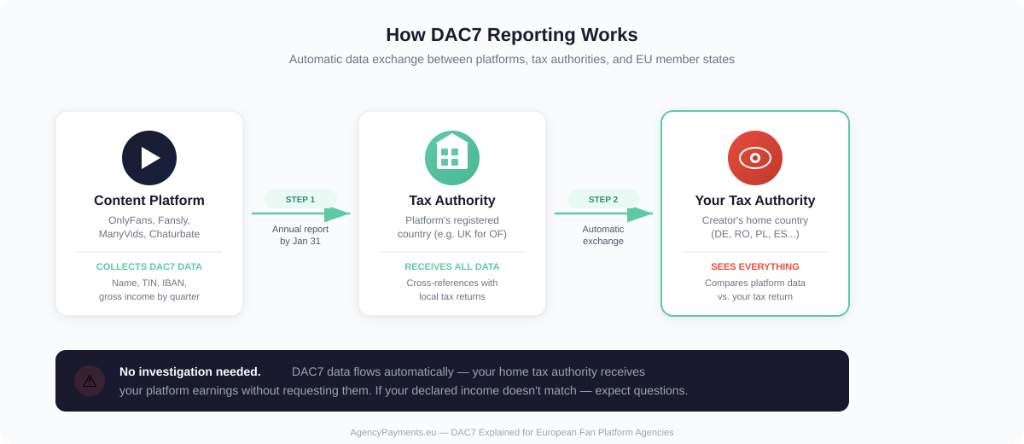
DAC7 stands for the Directive on Administrative Cooperation 7, formally known as Council Directive (EU) 2021/514. It is an EU directive that requires digital platforms to collect and report detailed information about users who earn income through those platforms.
The directive applies to any platform that facilitates the sale of goods, provision of personal services, rental of property, or — critically for this industry — delivery of digital content and services. That includes every major content platform where fans agencies operate.
DAC7 came into effect on January 1, 2024. Platforms were required to begin collecting creator information immediately, with the first reporting cycle covering the 2024 calendar year.
Here is how it works in practice. The platform collects identity and financial data from every creator. Once per year, the platform submits this data to the tax authority in the EU country where the platform is registered or has its reporting obligation. That tax authority then automatically shares the data with the tax authority in the creator's country of residence. This exchange happens between EU member states without any request or trigger — it is automatic and systematic.
This is not limited to OnlyFans. Fansly, ManyVids, Chaturbate, and any other platform where creators earn money from EU-based activity are covered. If the platform facilitates payments to creators, DAC7 applies.
What Data Do Platforms Report?
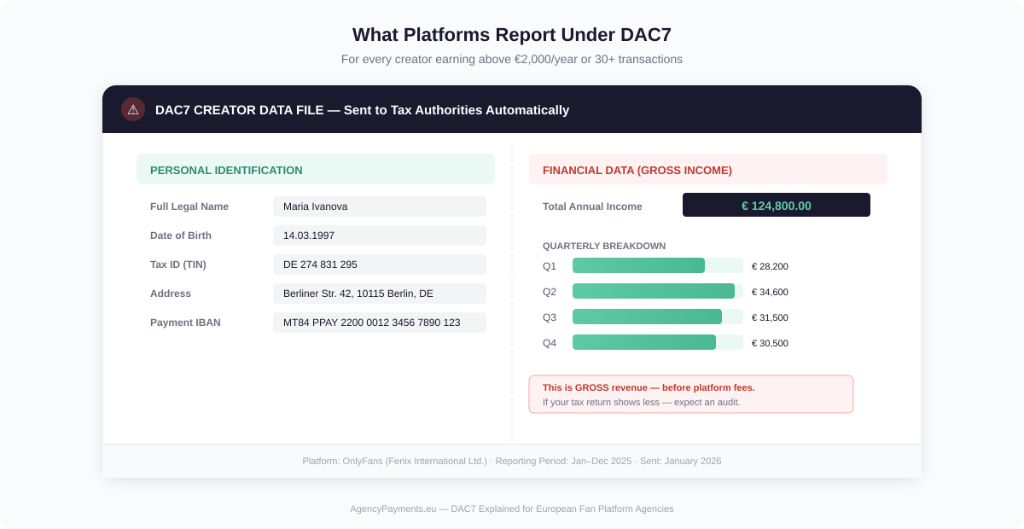
The scope of information that platforms must report is extensive. For every creator who exceeds the reporting threshold — more than €2,000 in annual earnings or more than 30 transactions in a calendar year — the platform reports the following:
The creator's full legal name, date of birth, and address. Their tax identification number in their country of residence. The payment account details (IBAN or equivalent) where the creator receives payouts. The total gross income earned on the platform during the calendar year, broken down by quarter.
This is gross revenue — the full amount before the platform takes its commission. If a creator's fans paid €150,000 in total and the platform retained 20%, the platform still reports the full figure or the 80% payout depending on local implementation. Either way, the tax authority sees a number that is significantly larger than what most creators declare as taxable income.
Platforms collect this information through the DAC7 form, which creators are asked to complete within their account settings. If a creator does not submit the required information, the platform is obligated to freeze their payouts until they comply. This is not optional — it is a legal requirement for the platform.
The data transfer to tax authorities happens automatically. There is no investigation, no suspicion, no audit trigger required. Every qualifying creator's financial data flows to their home country's tax office as a matter of routine.
Why This Matters Specifically for Agencies
If you are a solo creator, the DAC7 equation is simple: the platform reports your income, you declare it, you pay taxes on your profit after expenses.
For agencies, the situation is fundamentally different, because the money flows through the model — not through the agency.
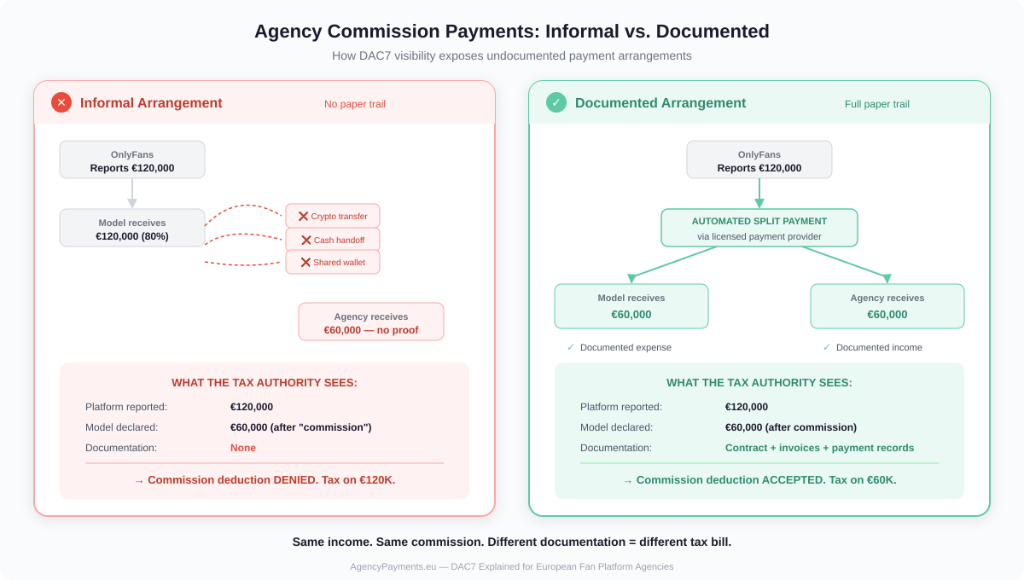
Here is the scenario that tax authorities now see clearly. The platform reports that Model X earned €120,000 on OnlyFans in 2025. Model X files a tax return declaring €120,000 in gross income but deducting €60,000 as an agency commission. The tax authority — which received the platform data automatically — now wants to see documentation for that €60,000 deduction.
This is where informal arrangements fall apart.
If the commission was paid via crypto transfer with no invoice, there is no documentation. If it was a manual transfer from the model's personal account with a note saying "commission," that is thin evidence. If the agency and model shared wallet access and the agency simply withdrew its share, there is no legitimate transaction record at all.
Without a proper service agreement, regular invoices or payment records, and a traceable payment flow through a licensed financial provider, the €60,000 deduction gets challenged. The model ends up paying income tax on the full €120,000. The model blames the agency. The relationship breaks.
On the agency side, the picture is equally problematic. If models pay you commissions through informal channels, your declared agency revenue may not align with what is now visible in the system. Tax authorities in multiple EU countries are already cross-referencing platform data with individual and corporate tax returns. The discrepancies are easy to spot.
DAC7 does not create new taxes. It creates visibility. And visibility is what makes informal financial arrangements untenable.
What Happens If You Do Nothing
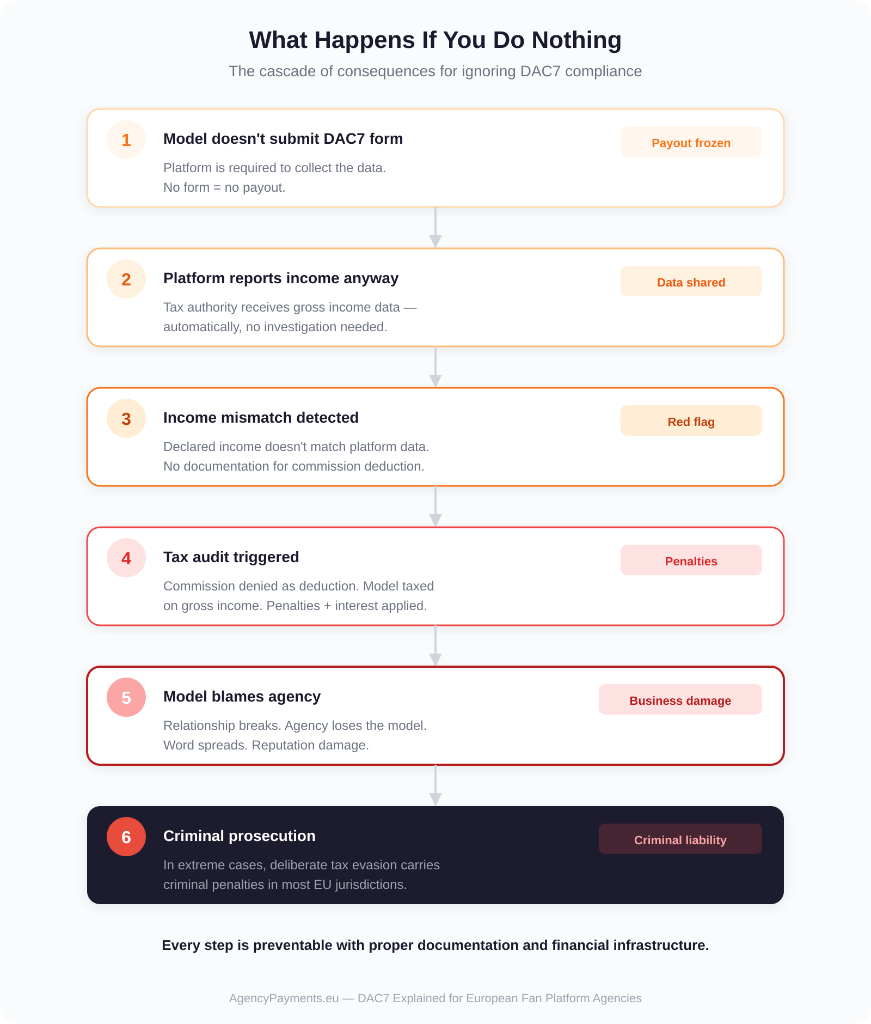
The consequences of ignoring DAC7 are concrete and escalating.
If a model does not submit their DAC7 information to the platform, the platform is required to suspend payouts. No form, no money. This is happening now — creators who ignored the platform's requests in 2024 have already experienced frozen accounts.
If a model's declared income does not match what the platform reported, the tax authority initiates a review. This typically starts with a written inquiry asking for clarification and supporting documentation. If the response is inadequate, it escalates to a formal audit. Outcomes include recalculated tax liability, penalties (often a percentage of the undeclared amount), and interest on late payments.
If the agency commission is not properly documented, the model loses the deduction. The model pays tax on gross income instead of net profit. This is a significant financial hit — on €120,000 of gross income with a 50% commission, the difference in tax liability can be tens of thousands of euros depending on the jurisdiction and tax rate.
If the agency's own income is not properly declared — because it arrived through informal channels that were never recorded — the agency faces its own tax consequences. These vary by jurisdiction but can include fines, back-payments, and in extreme cases, criminal prosecution for tax evasion.
This is not theoretical risk. EU tax authorities are actively using DAC7 data to identify discrepancies. The first enforcement actions based on 2024 reporting data are already underway in several member states.
What European Agency Owners Need to Do: A Practical Checklist
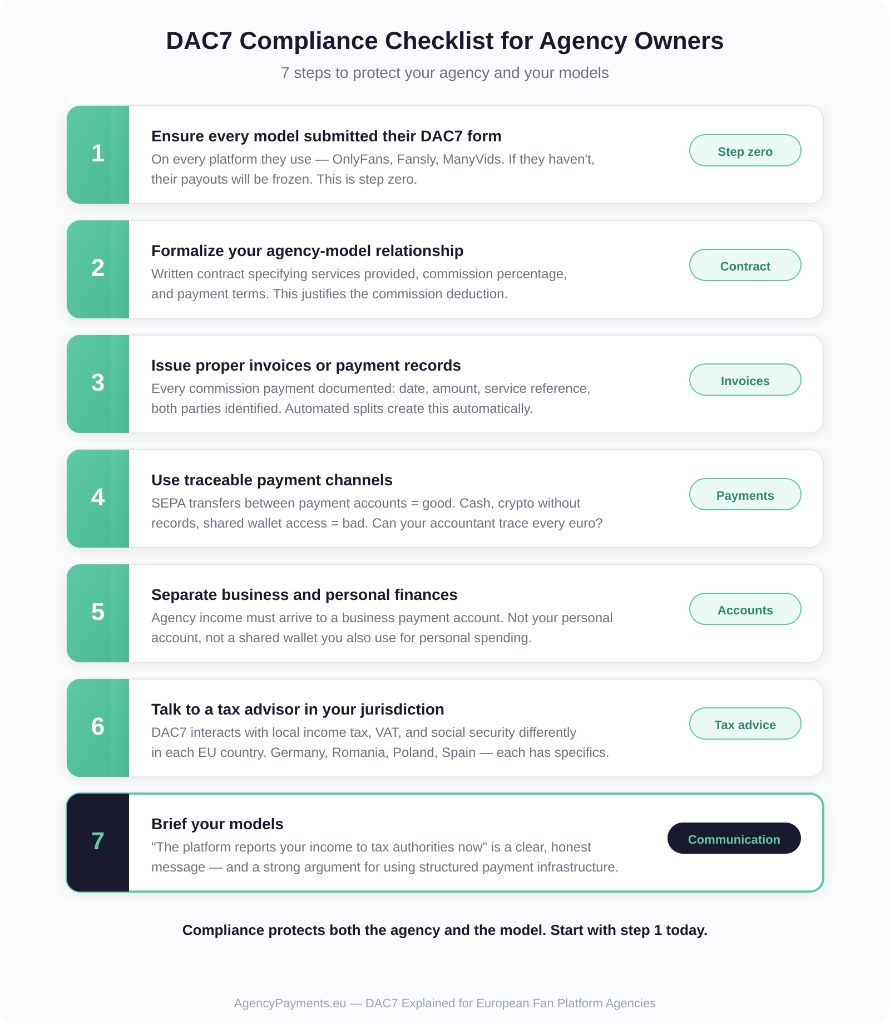
Here is what you need to have in place — not eventually, but now.
Ensure every model has submitted their DAC7 form. This is step zero. Every model who earns through a content platform and resides in the EU must complete the DAC7 information form on every platform they use. If they haven't, their payouts will be frozen. As an agency, make this part of your onboarding process — walk your models through it.
Formalize your agency-model relationship with a written contract. The contract must specify the services your agency provides (account management, content strategy, promotion, messaging), the commission percentage, the payment terms, and the notice period. This document is what justifies the commission as a deductible business expense for the model. Without it, the deduction is indefensible.
Create proper documentation for every commission payment. Every time your agency receives a commission, there should be an invoice or payment record. The invoice should reference the contract, the period it covers, the model's gross earnings, and the commission amount. This documentation needs to exist — it cannot be recreated after the fact if you are audited.
Use a payment provider that creates a traceable financial record. This is where your choice of payment infrastructure matters directly. If commissions flow through a licensed EMI — a provider like Blackcat or Yoursafe that issues EU IBANs and processes SEPA transfers — every payment appears as a clean, documented transaction in the banking system. If commissions flow through crypto wallets, informal transfers, or shared personal accounts, there is no banking record that supports your documentation.
Ensure your agency is properly registered and tax-compliant in its operating jurisdiction. If you are running an agency as a natural person without a registered business, DAC7 is a strong prompt to formalise. Operating as a registered business entity allows you to have proper business accounts, issue proper invoices, and deduct legitimate business expenses. Operating informally becomes increasingly untenable as the financial flows become visible.
Speak to a tax advisor who understands the digital creator economy. DAC7 compliance intersects with VAT obligations, corporate tax, and in some cases withholding tax. The rules vary by jurisdiction. A general accountant may not be familiar with the specific issues that arise in fan platform agency operations. Find an advisor who has experience with this sector.
Country-Specific Considerations
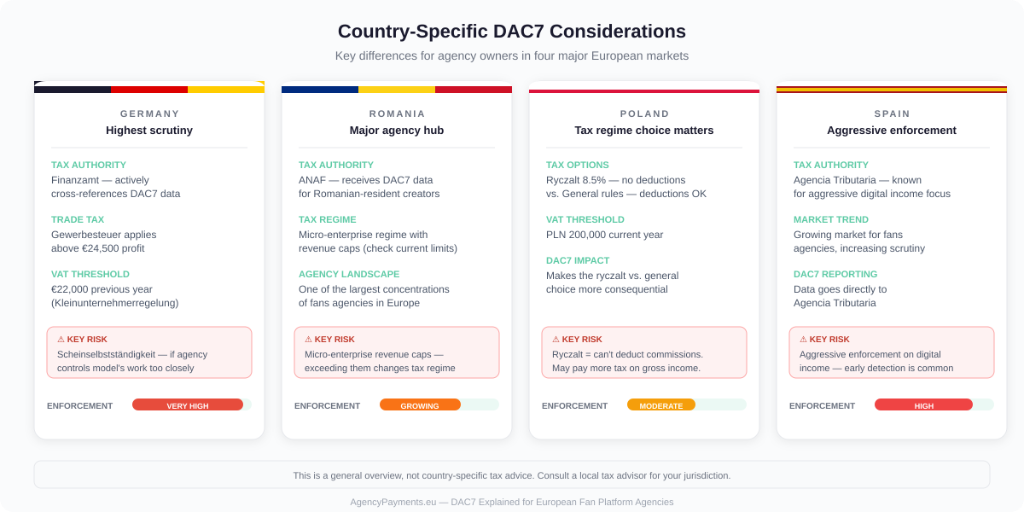
DAC7 data is shared with the tax authority of the model's country of residence. The implications vary significantly by jurisdiction.
Germany applies strict income tax rules to self-employed creators. German tax authorities (Finanzamt) actively cross-reference DAC7 data with Einkommensteuererklärung submissions. Trade tax (Gewerbesteuer) may also apply depending on business structure. Agency commissions deducted as Betriebsausgaben (business expenses) must be supported by documentation. Enforcement level: very high.
Romania is one of the largest concentrations of fans agencies in Europe. Romanian tax authorities (ANAF) receive DAC7 reports for resident creators. The micro-enterprise regime has revenue caps — exceeding them changes the tax regime entirely. Agencies must ensure commission documentation is clean to avoid reclassification issues.
Poland has a growing base of fans agency activity. Polish creators have a choice between the ryczałt flat rate (8.5%, no deductions) and general rules (deductions allowed). DAC7 makes the tax regime choice more consequential — undocumented commissions under ryczałt mean paying tax on full gross income.
Spain processes DAC7 data through the Agencia Tributaria, which is known for aggressive enforcement on digital income. Spanish creators are subject to IRPF income tax and may face IVA (VAT) obligations. Early detection of discrepancies is common.
If your agency operates in any of these countries, or if your models are resident there, DAC7 data is already flowing to those tax authorities. The question is whether your documentation matches.
The Payment Infrastructure Question
DAC7 has a direct implication for how you structure your payment flows, and this is where many agencies are underprepared.
The core issue is this: for commission payments to be defensible, they need to appear as legitimate business transactions in the financial system. That means they need to originate from a business account, reference an invoice, and land in the model's account with a clear payment reference.
This is exactly what automated split payment infrastructure is designed to do. When an agency operates through a provider like Blackcat, the commission split happens at the payment processing level. The agency's share goes directly to the agency's business account. The model's share goes to the model's account. Both transactions appear in the banking system with proper references. Both parties have clean documentation automatically.
This is not just convenient — under DAC7, it is arguably the most defensible payment structure available to an agency.
Yoursafe offers a similar capability with a 50% maximum split, which covers most standard commission arrangements. For agencies whose commission rates exceed 50%, Blackcat's uncapped split infrastructure is the relevant option.
The alternative — receiving commissions manually after the model's full payout has landed — is not inherently non-compliant, but it requires significantly more documentation discipline to maintain. Every transfer from model to agency needs to be documented, invoiced, and traceable. The burden is on the agency to maintain that paper trail.
Summary
DAC7 is not a threat to agencies that operate transparently. It is a compliance framework that makes informal arrangements untenable and pushes the industry toward professional financial infrastructure.
For agencies already operating with proper contracts, documented payments, and licensed payment providers, DAC7 changes relatively little. The data platforms share with tax authorities will align with what you are already declaring.
For agencies still relying on informal payment structures, crypto transfers, or undocumented commission arrangements, DAC7 represents a genuine and immediate risk. The visibility it creates is systematic and automatic. The enforcement actions it enables are already underway.
The practical response is not complicated: formalise your contracts, document your payments, and use payment infrastructure that creates a clean financial record by design.
If you are evaluating your payment infrastructure in light of DAC7, the comparison between Blackcat and Yoursafe — the two EU-regulated EMIs with automated split payment capability — is a useful starting point. Both provide the traceable, documented payment flows that DAC7 compliance requires.

