
High-Risk Payment Processing for Fans Agencies: What Actually Works in Europe
Why fans agencies get classified high-risk, what VIRP and Mastercard registration actually require, the 2026 VAMP chargeback thresholds, and which EU-licensed solutions fit an agency better than a generic high-risk acquirer.
High-Risk Payment Processing for Fans Agencies: What Actually Works in Europe
If you run a European fans agency, you have probably met the phrase "high risk" the hard way — a bank that declined your application, a Stripe account closed without much explanation, or a PayPal balance frozen while a six-figure payout sat just out of reach. Searching for "high risk payment processing" is usually where agency owners land next.
This guide explains what the label actually means for a fans agency in mid-2026, why mainstream providers turn you away, what the card schemes now demand (registration programs, chargeback thresholds, reserves), and which kinds of solutions are built for agencies managing multiple creators rather than for individual sellers.
What "High-Risk" Actually Means
"High-risk" is not a judgment about your business being illegitimate. It is a classification that banks, card networks, and payment providers apply to entire categories based on chargeback exposure, regulatory scrutiny, and reputational sensitivity. Adult and fans-platform activity sits squarely in that bucket — alongside gambling, crypto, CBD, and subscription billing.
In card-network terms, adult subscription content is typically coded under high-risk Merchant Category Codes — MCC 5967 (direct marketing / inbound teleservices) is the code most commonly applied to adult subscription billing. Once your activity maps to a high-risk MCC, a stricter rulebook applies: mandatory scheme registration, tighter underwriting, reserves, and close dispute monitoring.
There is a nuance most generic "high-risk processing" articles miss. Most fans agencies do not accept card payments from fans directly. The platform — OnlyFans, Fansly, and the rest — handles card acceptance and then pays out. So the agency's actual problem is rarely "how do I get a card-acquiring account." It is two different things:
- Acceptance: finding a financial institution that will knowingly take on a fans-economy business without freezing it later.
- Distribution: receiving those platform payouts and splitting them between the agency and its creators, cleanly and on time.
That distinction changes what you should actually be shopping for.
Why Mainstream Providers Decline You
Stripe, PayPal, Revolut, Wise, and most high-street banks aren't being arbitrary. Their published policies rule out adult activity directly: Stripe's restricted-business list prohibits "pornography and other mature audience content," and PayPal's acceptable use policy forbids certain sexually oriented materials and services, with the right to hold funds for up to 180 days.
The deeper reason sits above them. A mainstream processor that quietly carries adult volume without registering it risks card-scheme fines and its own standing with Visa and Mastercard, so the safe commercial choice is a blanket ban. Enforcement tends to be abrupt — account termination and fund holds of 90 to 180 days, not warnings.
For an agency, a frozen account mid-cycle means creators don't get paid, trust erodes, and you may spend months recovering held funds. (We cover the mechanics and prevention in why fans agencies get accounts frozen.)
The Card-Scheme Rulebook: VIRP and Mastercard Registration
When an acquirer does knowingly board adult-content business, both networks require formal registration — and the costs and obligations flow down to the merchant.
Visa runs this through the Visa Integrity Risk Program (VIRP), which replaced the older Global Brand Protection Program in 2023. Adult content sits in Integrity Risk Tier 1, the most scrutinised band, alongside gambling and pharmaceuticals. Since April 2024 the annual VIRP registration fee has been $950 per merchant, per acquirer — up from $500 — and Tier 1 merchants must run documented complaint processes, resolve reports of illegal or rule-violating content within set timeframes, and give anyone depicted in content an appeal route to contest consent.
Mastercard formalised its equivalent in 2021 with revised Specialty Merchant Registration standards for adult content merchants (announcement AN 5196, compliance required from 15 October 2021). The core obligations: verify the age and identity of every person depicted, hold written consent from each of them, review all content before publication, permit uploads only from verified content providers, run complaint and takedown processes, and file monthly activity reports to the acquirer. Registration costs $500 per year.
If a provider tells you it can process fans-economy card volume with none of this paperwork, that is not a shortcut — it is usually miscoded traffic, and miscoding is exactly what gets accounts terminated and funds held.
How High-Risk Processing Actually Works
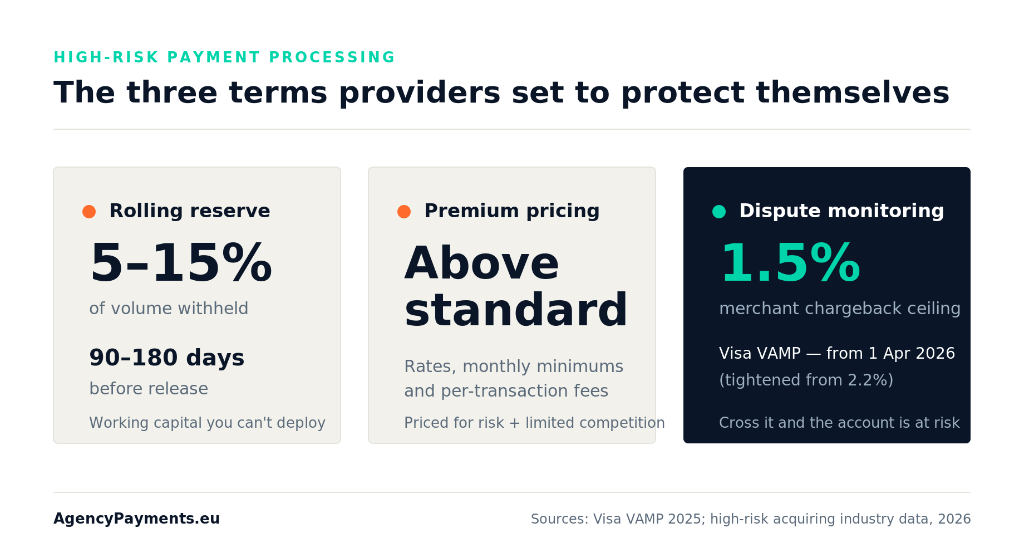
Beyond registration, a provider that accepts high-risk business structures the relationship to protect itself. Three mechanics show up repeatedly.
Rolling reserves. The provider withholds a percentage of processed volume as a buffer against later disputes — commonly 5–15% for high-risk accounts, held 90–180 days, then released on a rolling schedule. A 10% reserve on €100,000 of monthly volume means €10,000 sitting in reserve at any given time. That is real working capital you cannot deploy.
Premium pricing. Specialised high-risk acquirers price for the risk and for their limited competition. Headline rates, monthly minimums, and per-transaction fees run well above what a low-risk e-commerce merchant pays, and the scheme registration fees above are typically passed through on top.
Dispute monitoring. Card networks track your chargeback ratio continuously, and crossing a threshold triggers penalties for both you and your acquirer — which brings us to the numbers.
The Chargeback Math in 2026
Chargeback thresholds are not abstract. They are hard numbers that decide whether your account survives, and they tightened twice in the past eighteen months.
In April 2025 Visa consolidated its separate dispute and fraud monitoring programs into a single framework, the Visa Acquirer Monitoring Program (VAMP). The VAMP ratio counts both fraud reports and non-fraud disputes against settled transactions, so it is broader than the old chargeback-only measure. Two rounds of tightening followed:
- From 1 January 2026, the acquirer-portfolio "Above Standard" threshold moved to 0.5%, with "Excessive" at 0.7%. Acquirers over the line face enforcement fees that can reach $8 per disputed or fraudulent transaction — pressure they pass straight down to merchants.
- From 1 April 2026, the merchant-level "Excessive" threshold dropped from 2.2% to 1.5% across the US, Canada, and Europe. That ceiling is now in force.
Mastercard runs its own Excessive Chargeback Program with comparable escalation tiers.
The practical takeaway: in a fans context — subscription billing, "friendly fraud," partners spotting statement entries — dispute rates drift upward naturally. Staying comfortably under 1.5%, and ideally under the 0.5% level where you start dragging your acquirer's portfolio ratio, is a survival requirement. Providers that understand the sector build refund workflows, clear billing descriptors, and pre-dispute alerts for exactly this; generic ones cut you loose the moment a ratio moves.
The Climate in 2025–2026: Access Is Still Contested
Anyone who thinks payment access for adult-adjacent business is a settled question should look at July 2025, when pressure from card networks and processors — amplified by advocacy campaigns — led Steam to add a rule banning content that "may violate the rules and standards set forth by Steam's payment processors," and itch.io to deindex its entire adult catalogue overnight to preserve its processing relationships. Neither platform wanted to act; both concluded they had no choice.
The lesson for fans agencies is not panic — subscription platforms with mature compliance programs kept processing throughout. The lesson is concentration risk: any business whose revenue depends on a single payment relationship, or a single platform's payment relationships, inherits decisions made two or three layers above it. Agencies that keep their payout and distribution infrastructure with institutions that accept the sector knowingly, in writing, are structurally less exposed than those relying on tolerance.
Meanwhile the EU regulatory floor keeps rising. The Anti-Money-Laundering Authority (AMLA) in Frankfurt has been operational since July 2025 and took over the EBA's AML mandates in January 2026; the single EU AML Rulebook (Regulation (EU) 2024/1624) applies directly in all member states from 10 July 2027, and it makes enhanced due diligence mandatory for high-risk sectors rather than discretionary. Expect more documentation requests from any regulated provider, not fewer — and treat a provider that asks hard onboarding questions as a good sign, because it means they intend to keep you.
Generic High-Risk Acquirers vs Agency-Grade Solutions
This is where the acceptance-versus-distribution distinction pays off. Two very different kinds of provider get lumped together under "high-risk payment processing."
Generic high-risk acquirers exist to let a merchant accept cards in a risky category. If your agency genuinely takes card payments directly — an owned platform, direct sales — these are the relevant option, with the registration fees, reserves, and premium pricing described above. What they typically don't offer is anything tailored to how an agency distributes money to creators.
Agency-grade payment solutions approach the problem from the distribution side. Several are EU-licensed Electronic Money Institutions (EMIs) that knowingly serve the fans economy and add the feature agencies need most: automated commission splits. Funds arrive, and the incoming payment is divided automatically between the agency account and each creator's account by a pre-set percentage — no manual transfers, no spreadsheet reconciliation, no payout delays.
| Blackcat | MAKE | Yoursafe | |
|---|---|---|---|
| Regulator | EU EMI (MFSA, Malta) | Offshore | EU EMI (DNB, Netherlands) |
| EU IBAN | ✓ | ✗ | ✓ |
| SEPA | ✓ (SCT + Instant) | ✗ | ✓ |
| Automated split | ✓ | ✓ | ✓ |
| Max split % | No limit | Not published | 50% cap |
| Cards | Mastercard (physical + virtual) | Coming soon | Visa Debit |
| Split fee | 0.50% – 1.50% (volume-tiered) | 1.99% flat | Not published |
The EU EMIs in this group (Blackcat and Yoursafe) safeguard client funds under European e-money rules and provide EU IBANs with SEPA access. That matters more than it used to: under the Instant Payments Regulation (EU) 2024/886, eurozone EMIs have been required to send and receive instant euro transfers since October 2025, at no premium over standard credit transfers — so with an EU-licensed provider, ten-second creator payouts are now the legal baseline rather than a paid extra. EU rails also keep you cleanly inside DAC7 and AMLA reporting expectations, which is worth something now that tax authorities hold several years of platform-reported creator income data. MAKE offers automated splits but operates offshore, without an EU IBAN or SEPA. One practical constraint worth flagging: Yoursafe caps splits at 50%, which rules it out for the standard 50–80% commission agreements most agencies run.
What European Fans Agencies Actually Need
Stripping it back, an agency moving five- or six-figure monthly volumes across multiple creators needs:
- Knowing acceptance from a provider that has classified your business correctly and accepted it in writing — not a mainstream service operating a blanket ban it hasn't enforced yet.
- Automated commission splits that execute the moment funds arrive, with a configurable percentage per creator.
- EU regulatory standing — safeguarded funds under EMI rules, an EU IBAN, SEPA Instant — so compliance scales with revenue instead of becoming a liability as AMLR lands.
- Predictable economics — transparent, ideally volume-tiered fees, without large rolling reserves tying up working capital.
- Operational tooling — multi-creator tracking, batch payouts, clean records for tax and DAC7 season.
A generic high-risk acquirer can solve card acceptance. It rarely solves distribution, reserves, or EU compliance in one place. That gap is what agency-grade EMIs are built to close.
Bottom Line
"High risk" is a label the payments industry assigns to your whole category — not a verdict on your agency. The mainstream providers that decline you are following network rules; the acquirers that accept you do so under a formal regime (VIRP Tier 1, Mastercard specialty registration, VAMP thresholds) with costs designed to price the risk. The 2025–2026 platform delistings showed how fast tolerated access can vanish, and the tightened 1.5% dispute ceiling leaves less room for error than ever.
For a European fans agency, the more useful question is not "who will process high-risk cards" but "who will accept my business knowingly, keep it compliant under EU rules, and split payouts to my creators automatically." That reframes the search away from card acquiring and toward agency-grade infrastructure.
Use our free comparison calculator to see how different providers compare for your specific volume and commission structure, or read how to choose a payment provider for your fans agency.
AgencyPayments.eu is an independent informational resource. We are not affiliated with Blackcat, MAKE, Yoursafe, or any other payment provider mentioned in this article. Card-network figures, regulatory dates, and provider details are sourced from publicly available information, current as of July 2026, and may change.

