
Crypto vs SEPA: Why European Fans Agencies Are Moving to Traceable Payments
Crypto solved a real problem when nothing else worked for the adult content industry. But DAC7, AMLA, and tightening AML rules have changed the calculation. Here is why SEPA-based infrastructure is becoming the standard for European fans agencies.
Crypto was not the first choice for European fans agencies. It was the available choice.
For years, the mainstream financial system had a simple answer for adult content businesses: no. Accounts closed without explanation. Transfers from content platforms triggered automatic flags. Payment providers that seemed fine during onboarding quietly exited when the nature of the business became apparent.
Crypto filled the gap. It was fast, it crossed borders without institutional gatekeepers, and it did not ask what your business did. For agencies managing models across multiple countries, receiving commissions in USDT or BTC was not an ideological position — it was a practical workaround to a system that excluded them.
That context matters. But the context has changed.
DAC7 is live. AMLA is operational. EU tax authorities now receive systematic data on creator earnings. AML requirements for high-risk sectors have been tightened across the board. And the definition of "compliant financial infrastructure" has shifted in ways that crypto arrangements — even well-intentioned ones — struggle to satisfy.
This is why a growing number of European fans agencies are moving toward SEPA-based payment infrastructure. Not because crypto stopped working technically. Because the regulatory environment changed what "working" means.
What Crypto Actually Solved
Before exploring why SEPA is increasingly the right answer, it is worth being precise about what crypto solved — because the problem was real.
The core issue was access. Licensed European payment providers would not touch adult content businesses. Those that did often reversed course after the first content platform transfer arrived. The options were: find a niche provider with limited functionality, use shared wallet access with all its compliance implications, or route commissions through crypto.
Crypto offered: speed (transfers in minutes regardless of jurisdiction), accessibility (no institutional approval required), and flexibility (cross-border by default, no IBAN required).
For agencies where the alternative was manual cash-like arrangements or no reliable commission flow at all, crypto was a genuine operational solution.
Why Crypto Creates Compliance Problems in 2026
The same properties that made crypto useful — speed, accessibility, lack of institutional friction — are the properties that create compliance problems in the current regulatory environment.
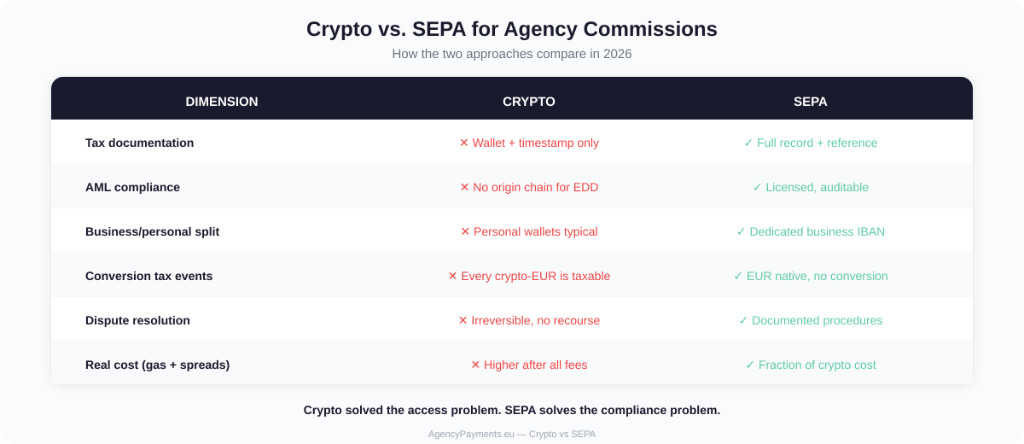
Documentation gaps. A USDT transfer with a memo note is not documentation. Under DAC7, agencies need records that link the platform-reported creator income to the documented commission deduction. A crypto transaction on a public blockchain confirms that funds moved. It does not confirm the business purpose, the agreed percentage, the counterparty relationship, or the service rendered. Tax authorities cross-referencing DAC7 platform data against declared commission expenses need more than a wallet address and a timestamp.
AML exposure. Under AMLA-aligned rules, licensed payment institutions are required to know the origin and purpose of funds flowing through their systems. When an agency receives crypto transfers from models as commission payments, those funds may have no documented origin chain that satisfies EDD requirements. An agency operating under a licensed EMI framework and also receiving significant crypto transfers outside that framework has a profile that AML compliance systems are specifically designed to flag.
Banking friction. Even when crypto transactions are legitimate and well-documented, converting them into euros and depositing them into a business account creates a secondary documentation burden. The agency must demonstrate to their licensed account provider the source of the funds. A growing number of EU-licensed institutions apply strict scrutiny to funds originating from crypto — particularly for businesses in high-risk sectors. The practical effect: crypto income may be difficult to surface into your declared business accounts without triggering reviews.
Counterparty risk. Crypto transfers are irreversible. If a model sends the wrong amount, sends to the wrong address, or disputes the transaction, there is no recourse mechanism. With a SEPA transfer through a licensed provider, there are documented procedures for disputes, reversals, and record reconciliation. For commission arrangements that may be contested, this matters.
Tax treatment uncertainty. In several EU jurisdictions, crypto-to-euro conversion events are themselves taxable. An agency receiving commissions in USDT and converting to EUR is potentially realising gains or losses on the conversion in addition to the income itself. This creates a parallel accounting requirement that most agencies are not set up to handle correctly.
What SEPA Infrastructure Actually Provides
The shift toward SEPA-based payments is not purely about regulatory compliance. It is also about what SEPA infrastructure delivers operationally.
Clean documentation by default.
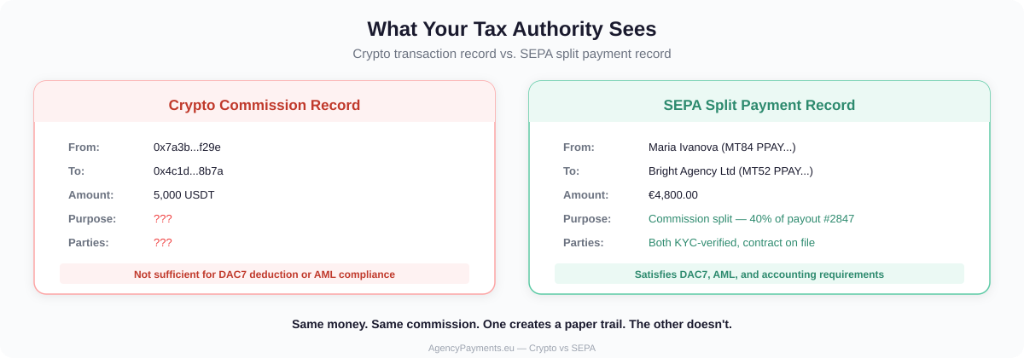 Every SEPA transfer generates a verifiable record: date, amount, sender IBAN, recipient IBAN, and a reference field. When agency commission flows through automated split payments, both parties receive transaction confirmations tied to specific payouts. The model has documentation of the commission paid. The agency has documentation of the commission received. Both records are in a format that satisfies DAC7 requirements, AML documentation requirements, and standard accounting workflows.
Separation of business and personal funds. A licensed EMI business account separates the agency's commission income from personal finances structurally, not just by convention. This separation is a basic requirement in virtually every EU jurisdiction for business tax purposes — and it is one that crypto arrangements, typically routed through personal wallets, cannot provide.
Regulatory standing. Operating within licensed financial infrastructure gives the agency a documented, auditable financial history. When a tax authority, a potential business partner, or a compliance review asks to see the agency's financial records, a clean SEPA transaction history through a licensed provider is materially more credible than a series of blockchain wallet transactions.
Speed and cost. Modern SEPA instant credit transfers settle in seconds. The cost of a SEPA transfer is typically a fraction of the cost of a crypto transfer once gas fees and conversion spreads are factored in. For agencies processing multiple model payouts per week, the cost differential compounds quickly.
No conversion events. SEPA operates in euros. There are no conversion events, no crypto gain/loss calculations, no secondary tax implications from moving between currencies or asset classes. The euro arrives, the commission routes, the records update. One transaction, one tax event, one line in the accounts.
The Migration Question: How to Move From Crypto to SEPA
For agencies currently using crypto for commission flows, the migration to SEPA infrastructure is operationally straightforward but requires planning.
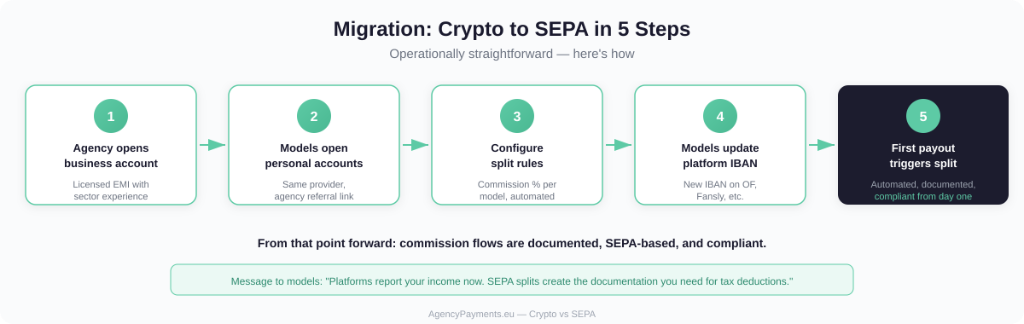
The core steps are: the agency opens a business account with a licensed EMI that serves the adult content sector; each model opens a personal payment account with the same provider using the agency's referral link; split payment rules are configured to the agreed commission percentage; the model updates their payout settings on OnlyFans, Fansly, or other platforms to the new personal account IBAN; and the first payout triggers the automated split.
From that point forward, commission flows are documented, SEPA-based, and compliant.
The transition period requires some attention. Models who currently send crypto commissions need to be communicated with clearly about why the change is happening and what the process looks like. The message is honest and straightforward: platforms now report income to tax authorities, the commission must be documented to be deductible, and SEPA splits create that documentation automatically. For models who understand the tax implication — that an undocumented commission cannot be deducted, and that they would be paying income tax on gross rather than net income — the incentive to switch is clear.
What Happens to Crypto Arrangements That Predate the Switch
This question requires a qualified tax advisor, not a content platform. But a few general points are worth noting.
Historical crypto commission flows are not automatically a problem. The issue is whether they were declared correctly: whether the agency declared the income, whether the models declared and deducted the commissions, and whether the documentation supports those declarations if reviewed.
For agencies with clean historical declarations where the numbers add up, moving to SEPA infrastructure going forward is the right step and historical exposure is limited.
For agencies where historical declarations were incomplete, the approach depends on jurisdiction, amounts, and existing records. Proactive disclosure to the relevant tax authority — before being identified through DAC7 cross-referencing — is generally treated more favourably than discovered underdeclaration. This is a conversation to have with a local tax advisor now, not later.
The Broader Shift: Infrastructure as Legitimacy
The move from crypto to SEPA is part of a broader pattern. European fans agencies that started as informal operations are scaling into structured businesses — with formal company registration, professional contracts, licensed financial infrastructure, and declared income that matches what tax authorities now see in the DAC7 data.
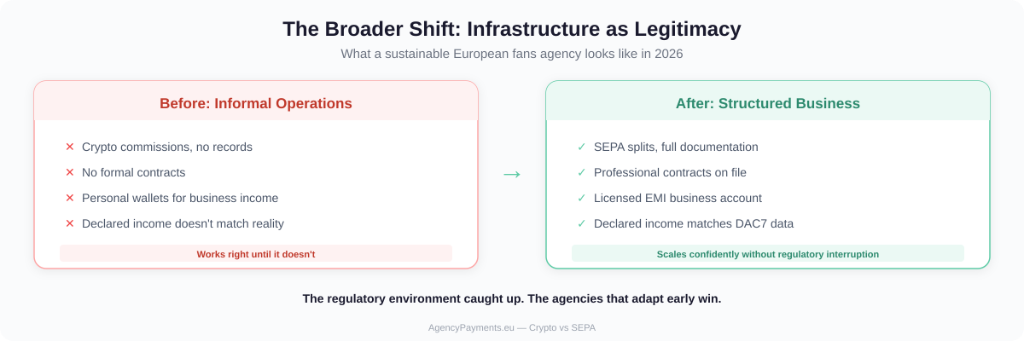
This is not a compliance burden imposed from outside. It is what a sustainable European business looks like in 2026. The regulatory environment has caught up with the industry. The agencies that adapt early build the infrastructure that lets them operate confidently at scale. The ones that resist are running a model that works right until it doesn't.
Crypto solved the access problem when access was the problem. SEPA infrastructure solves the compliance problem — which is now the problem that matters.
AgencyPayments.eu provides informational content for fans agency owners in Europe. This article does not constitute financial, tax, or legal advice. Consult a qualified professional in your jurisdiction for advice specific to your situation.

