
Commission Split Structures & Contracts for Fans Agencies
The commission split is the core commercial term of any fans agency. Here is how the four common models work, what the market charges in 2026, the contract clauses that prevent disputes, and why executing the split at infrastructure level matters as much as the percentage.
Commission Split Structures & Contracts for Fans Agencies
The commission split is the single most important number in a fans agency. It defines the relationship with every creator, sets the economics of the whole business, and — handled badly — becomes the source of most disputes. Yet many agencies still set it casually, write it into a two-page template found online, and execute it manually every payout cycle. That combination creates friction exactly where trust matters most.
This guide covers the commission models agencies actually use, what the market charges in 2026 and why, the clauses a split agreement needs to survive a disagreement, and why how you execute the split has become as important as the percentage itself.
What a Commission Split Is
A commission split divides each creator's earnings between the creator and the agency. If a creator's account generates €10,000 in a cycle and the agreement is a 50/50 split, €5,000 goes to the creator and €5,000 to the agency in exchange for the services the agency provides — management, marketing, chatting, growth.
Simple in principle. The complexity is in the details: which model you use, what base the percentage applies to, when the money moves, and whether the process is automatic or manual.
The Four Models in Use
Flat percentage. One rate on everything, every month. Easy to explain, easy to automate, and by far the most common structure. Its weakness appears at scale: the agency's absolute take grows with the creator's revenue even if the agency's workload doesn't, which is exactly when established creators start renegotiating.
Tiered by revenue. The rate steps down as monthly earnings climb — say 45% up to €10,000, 35% from €10,000 to €25,000, 25% above that. Tiering answers the renegotiation problem in advance and gives creators a visible reason to stay as they grow. It is harder to run by hand, which is one reason smaller agencies avoid it and shouldn't.
Service-scoped. Different rates for different work: one percentage on revenue the agency's chatters generate, a lower one (or none) on organic subscription income the creator brought in. Fairest on paper, and the most demanding to track — it only works if your platform statistics can actually separate the revenue streams.
Hybrid with a base fee. A fixed monthly retainer plus a reduced percentage. Common where the agency carries hard costs — paid advertising, content production — that a pure commission wouldn't cover for a creator starting from zero. The retainer needs particular care in the contract, because it is the part creators most often feel they didn't understand.
What the Market Actually Charges
Across published 2025–2026 industry pricing, most legitimate agencies take between 20% and 50% of creator earnings. Within that band, the rate tracks the scope of work fairly reliably:
- 20–30% — chatting-only or marketing-only arrangements, where the creator still runs their own account and content.
- 30–50% — full-service management: strategy, chatting, marketing, scheduling, and day-to-day operations handled by the agency.
- Above 50% — full-takeover or incubator deals, where the agency funds promotion and builds a page from nothing. These exist and can be legitimate, but the burden is on the agency to show what justifies the rate.
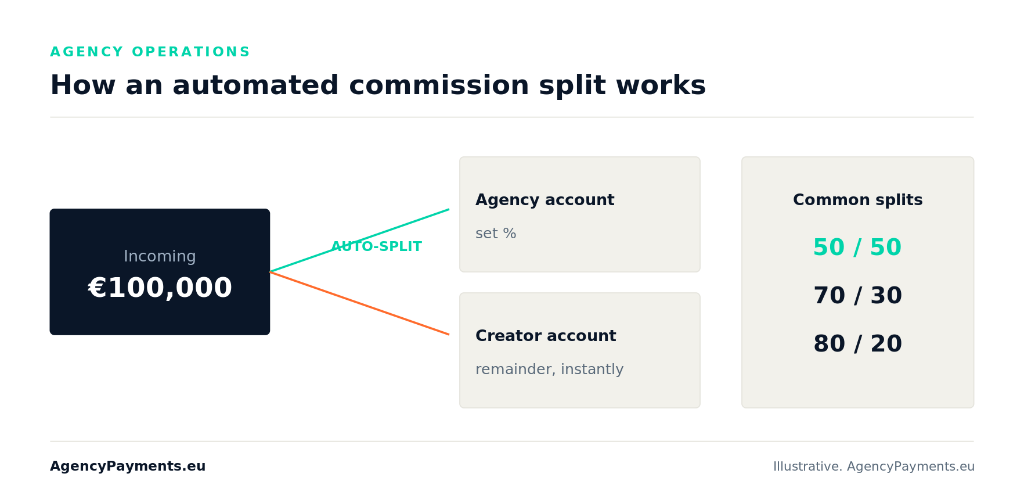
The rates converge for a structural reason: full-service management is labour. Round-the-clock chatting coverage alone typically means several paid shifts per creator, before anyone touches marketing or content planning. An agency charging 20% for genuine full service is usually either losing money or not delivering the service; one charging 60% for chatting alone is simply overpriced. The old shorthand of 50/50, 70/30 and 80/20 (creator share first) still maps onto these tiers. What has changed is transparency: creators comparing agencies in 2026 can find rate benchmarks in minutes, so a rate above the band for the service level offered now costs you signings. There is no "correct" split — only one that honestly reflects who does what. The mistake is picking a number without defining what it applies to.
The Payout Math, Worked Through
Say a creator bills fans €20,000 in a month. The platform keeps its 20% fee, so €16,000 arrives as the payout. Now the single most consequential word in your contract does its work:
- 40% commission on net platform earnings — the agency takes 40% of €16,000. Agency: €6,400. Creator: €9,600.
- 40% commission on gross billings — the agency takes 40% of €20,000, or €8,000, out of a €16,000 payout. Creator: €8,000.
Same headline rate; the creator's income differs by €1,600 a month depending on whether the base is gross or net. Add deductions and it moves again: if €1,000 of agreed ad spend comes off before the split, the net-based version becomes €6,000 to the agency and €9,000 to the creator. None of these structures is wrong — but a creator who discovers the difference after the first payout, rather than in the contract, is a creator you are about to lose.
The Contract Clause Checklist
A split agreement does its job when both sides can answer any money question by pointing at a clause. The checklist:
- Scope of services. What the agency actually does — chatting, marketing, content planning, account management — listed specifically. Vague scope is the root of most "what am I paying for" disputes.
- The split itself. The percentage, the model (flat, tiered, scoped, hybrid), and above all the base: gross billings or net platform payout, and which platforms and revenue types it covers.
- Payment mechanics. Where fan revenue lands, who controls that account, how often the split runs, and how quickly each party's share is forwarded once funds arrive. A concrete number — "within three business days of platform payout" — beats "promptly" every time.
- Transparency. What the creator can see: their own earnings data, the split calculation, and any deductions, ideally in real time rather than as a monthly summary they have to request.
- Deductions. What comes off before the split — ad spend, tools, production costs — with a documentation requirement for every deduction.
- Term and termination. Fixed term or rolling, notice periods, grounds for immediate termination, and what happens to in-flight earnings and pending payouts when the relationship ends.
- Exclusivity. Whether the creator may work with other agencies or self-manage on other platforms, defined narrowly. Broad exclusivity paired with a high commission is both a negotiation problem and — as covered below — a legal one.
- Content rights. Who owns content produced during the term, what licence the agency holds, and what happens to accounts, handles and content archives at exit. Creators should almost never assign copyright outright to a management agency.
- Confidentiality and data protection. The agency processes deeply personal data — identity documents, earnings, sometimes intimate content. GDPR obligations, retention limits and breach responsibilities belong in the contract, not in goodwill.
- Dispute resolution and governing law. Which country's law applies and where disputes are heard. In cross-border EU arrangements this is routinely left out, and it is the clause you miss most when things go wrong.
Clarity here is not legalism; it is the thing that keeps a good creator relationship from souring over a misunderstanding about money.
Why the Split Should Run at Infrastructure Level
Once the percentage is agreed, someone has to actually divide the money — and this is where a well-drafted contract either becomes operational reality or stays a PDF.
Manual execution means calculating each creator's share every cycle and sending individual transfers by hand. With five creators it's tedious; with twenty it's a real staffing cost, and every manual step is a chance for an error or a late payment that damages trust. A contract enforced by spreadsheet is enforced by whoever updates the spreadsheet.
Automated execution turns the contractual percentage into a payment rule. With an agency-grade provider, the split is configured once, and every incoming payment divides automatically between the agency account and each creator's account the moment funds arrive. The contract and the money flow become the same thing — the agreed percentage cannot quietly drift, and neither side has to chase the other. We explain the mechanics in how automated split payments work.
There is a compliance dividend too. Since DAC7 reporting began, EU tax authorities receive creators' platform earnings annually and have been cross-checking them against declared income. An automated split produces a clean, timestamped record of what was earned, what was divided and what was forwarded — documentation that matches the contract, generated as a by-product of running.
One practical constraint: if your agreements sit at 50% commission or higher, not every provider can execute them. Among agency-grade options, Yoursafe caps automated splits at 50%, while Blackcat applies no percentage limit and MAKE does not publish one. On cost, the differences are just as concrete — at a 50/50 split on €100,000 of monthly volume, expect roughly €625 per month on Blackcat's marginal tiers against €995 on MAKE's 1.99% flat rate. Check your actual numbers in the free calculator and the full provider comparison.
The Employment Question: Control vs Independence
A commission contract assumes the creator is an independent contractor. That assumption is now under more scrutiny than it used to be. The EU Platform Work Directive (2024/2831) must be transposed into national law by 2 December 2026, and it introduces a rebuttable presumption of employment where the facts show direction and control — with the burden of proof on the business, not the worker.
The directive targets digital labour platforms, and a management agency is not automatically in scope. But the direction of travel matters, because the same control test already exists in national misclassification law across the EU. An agency that dictates posting schedules, sets content quotas, controls the creator's account credentials, demands exclusivity and takes 50%+ of revenue looks, to a labour inspector, considerably more like an employer than a service provider. Reclassification means back-dated social contributions, holiday pay and dismissal protection — retroactively, at agency expense.
The practical hedge is to draft and behave like a genuine B2B relationship: the creator keeps ownership of their accounts and content, retains final say over what is published, and can decline work. If your business model only functions with employee-level control, price in employee-level obligations.
Red Flags — In Both Directions
For creators evaluating an agency contract:
- Commission above 50% without funded advertising or production to justify it.
- A split applied to gross billings presented as if it were net.
- Copyright assignment instead of a licence, or the agency holding account credentials with no exit provision.
- Auto-renewing multi-year terms with penalty clauses for leaving.
- No stated payout timing — "we pay when we pay" is not a term.
For agencies evaluating a creator (or their own template):
- No written agreement at all — common, and indefensible once real money flows.
- Undefined deductions, which will eventually be disputed even when legitimate.
- Exclusivity plus scheduling control plus high commission — the reclassification profile described above.
- Splits executed from a personal bank account, which mixes funds, muddies the DAC7 paper trail, and is a frequent trigger for the account freezes we cover in why agencies get accounts frozen.
Bottom Line
Set a rate the market recognises for the service level you actually deliver. Write it into a contract that fixes the base, the mechanics, the exit and the ownership questions before they become arguments. Keep the relationship structured as genuine independence, because from December 2026 the control question gets sharper, not softer. And then execute the split at infrastructure level, so the percentage in the contract and the percentage in the payment flow are always the same number. Get those right and the most sensitive number in your business runs quietly in the background.
See how splits behave as you grow in scaling a fans agency, or compare providers in our free calculator.
AgencyPayments.eu is an independent informational resource. We are not affiliated with any payment provider mentioned. This article is general information, not legal advice — have agreements reviewed by a lawyer in your jurisdiction. Current as of July 2026.

