
How Automated Split Payments Work for European Fans Agencies
How automated split payments solve the commission collection problem for European fans agencies — and why DAC7 makes proper financial infrastructure essential.
If you run a fans agency registered in the EU, your business depends on one thing working reliably: getting paid your commission.
The problem is well-known. Content platforms pay creators directly. The creator receives the full payout. Your share - the commission you earned by managing their account, running their promotion, handling their messages - depends on the model sending it to you. Manually. On time. Every time.
Sometimes they do. Sometimes they forget. Sometimes they disappear.
For a European agency operating under increasing regulatory pressure - including DAC7 reporting, VAT obligations, and stricter AML requirements - informal payment flows are no longer just inconvenient. They are a compliance risk.
Automated split payments solve this at the infrastructure level. When a model receives a payout from a content platform, a pre-agreed percentage is automatically routed to the agency's business account. No manual step. No chasing. No ambiguity.
This guide explains how the mechanism works, what it means for your agency's finances and tax position, and how to evaluate whether it fits your setup.
Why Commission Collection Is Broken for Most European Agencies
The standard payout flow in the fans industry looks like this: a subscriber pays on the platform, the platform takes its cut (typically 20%), and the remaining 80% goes to the creator's payout account. That payout account belongs to the model - not the agency.
This means the agency's commission - whether it is 30%, 50%, or 70% - sits in someone else's account. The model is supposed to send it. But there is no mechanism forcing it to happen.
European agency owners know the workarounds, and they know why each one creates problems.
Shared access to payment wallets such as Paxum or Skrill is a common approach. The agency controls the wallet, withdraws the funds, and sends the model their share. This reverses the trust problem - but it creates a compliance issue. Accessing another person's financial account without proper authorization raises regulatory red flags, especially in EU jurisdictions where fund segregation rules apply.
Informal crypto transfers solve the speed problem but destroy the paper trail. When your accountant asks for documentation of income, "she sent me USDT on Binance" is not an invoice. Under DAC7, where platforms now report creator earnings to EU tax authorities, undocumented income flows create exposure for both the agency and the model.
Manual transfers on trust work with reliable models - until they don't. When you manage 15 or 20 creators across multiple countries, even a small percentage of late or missing payments creates real cash flow problems. And the time spent chasing payments is time not spent growing the business.
The core issue is structural: the industry's payout model was designed for individual creators, not for agencies that provide services and need predictable revenue.
What Automated Split Payments Actually Are
An automated split payment is a financial mechanism where incoming funds are divided between multiple parties based on pre-configured rules. In the context of a fans agency, it works like this:
- The model receives a payout from a content platform (OnlyFans, Fansly, or any other platform supporting SEPA transfers) to their personal payment account.
- The payment provider automatically deducts the agreed commission percentage.
- The agency's share is instantly transferred to the agency's business account.
- Both parties receive a record of the transaction.
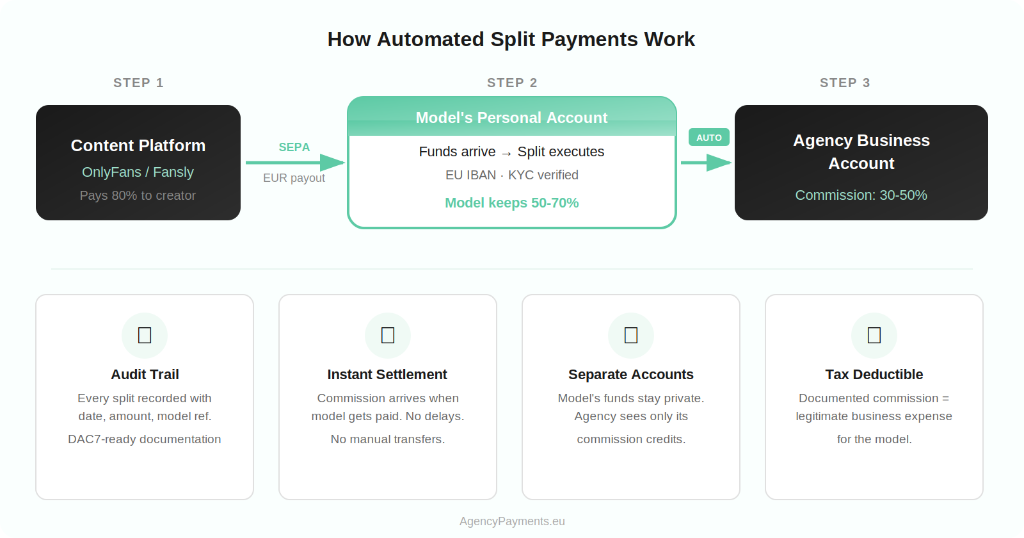
This happens at the payment provider level - not on the content platform itself. The platform does not need to know about the split. It simply sends the payout to the model's IBAN as usual.
An important distinction: this is not the agency "taking" money from the model's account. The model agrees to the commission terms during onboarding. The split is a configured financial service, executed transparently, with both sides seeing exactly what happens.
The concept itself is not new. Marketplace platforms, gig economy apps, and affiliate networks use similar revenue-sharing mechanisms. What is relatively new is its application in the fans agency space, where the relationship between agency and creator has historically been managed informally.
Step by Step: How a European Agency Sets This Up
The setup process is straightforward and does not require any technical integration or development work. Here is how it typically works.
Step 1: The agency opens a business account. Your company must be registered - in any non-sanctioned jurisdiction. You go through a standard KYB (Know Your Business) verification: company documents, director identification, proof of address. This takes a few days depending on the provider.
Step 2: You receive a referral link. This is a unique registration link tied to your agency. Every model who registers through this link is associated with your agency's commission structure.
Step 3: The model registers. Your model follows the referral link, opens a personal account, and completes KYC (identity verification). During this process, the model reviews and agrees to the commission split terms - the percentage, the notice period, and the conditions.
Step 4: Commission rules are configured. The provider sets up the split logic according to your agreement. Percentages can vary per model. Some providers allow different rates per income source or platform.
Step 5: The model redirects their platform payouts. The model updates their payout settings on OnlyFans, Fansly, or whichever platform they use, pointing withdrawals to their new payment account IBAN.
Step 6: Payouts arrive, splits execute. When the model withdraws from the platform, funds land in their personal account. The commission is deducted automatically and credited to the agency's business account. Both sides receive transaction records.
The entire process - from agency account approval to the first model onboarded - can be completed in under two weeks. Model onboarding itself takes minutes.
What Happens with Models Outside the EU?
Many European agencies manage models who live outside the European Union - in Ukraine, Colombia, the Philippines, Serbia, and elsewhere. This is normal, and automated splits can still work, but there are nuances.
The key question is whether the model can open a personal account with the split payment provider. Requirements vary: some providers accept residents of most non-sanctioned countries, while others are limited to specific regions.
If the model is eligible, they open an account and the split functions identically to the EU-based scenario. However, there is a meaningful difference in what the model gets.
A model based in the EEA typically receives a personal payment account with a European IBAN. This is a significant benefit: SEPA transfers from content platforms arrive faster, there are no currency conversion fees for EUR payouts, and the model can use the account for everyday spending via a card. This is something not every provider offers - and it is a genuine competitive advantage when you are onboarding European models.
For models outside the EU, the account may not include a European IBAN, depending on the provider and the model's country of residence. Payouts from the platform may still work (if the platform supports international transfers), but the experience differs.
From the agency's perspective, the critical question is simpler: does your commission arrive to your EU business account in EUR, with proper documentation? If yes, the model's geographic location is a secondary concern. Your books stay clean regardless.
How to Evaluate a Split Payment Provider
Not all providers offering split payment services are equal, and the wrong choice can create more problems than it solves. Here is what to assess.
Is the provider licensed in the EU? Look for an Electronic Money Institution (EMI) authorisation from an EU financial regulator. A licensed EMI operates under supervision, follows fund safeguarding rules, and provides the regulatory framework your agency needs. An offshore entity or an unlicensed company introduces risk - for your funds and your reputation.
Do they have experience with the adult content industry? This is non-negotiable. Many payment providers will accept your application, process your first few transactions, and then freeze your account the moment they see an inbound transfer from a content platform. This happens regularly. Before onboarding, ask directly: how many fans agencies do you currently serve? How long have you been working with this industry?
Do they support SEPA? Your commission should arrive as a standard SEPA credit transfer to your business IBAN - not as an internal wallet balance that you then need to withdraw through additional steps. A proper SEPA transfer gives you a clean, verifiable transaction record that your accountant can work with.
Are split rules configurable? You may have different commission rates with different models. A provider should support per-model configuration, and ideally allow adjustments without requiring you to close and reopen accounts.
What does the reporting look like? You need monthly statements showing each split: date, amount, percentage, model reference. This documentation is essential for tax reporting, especially under DAC7, where your declared income must align with what platforms report about your models' earnings.
What is the cost structure? Understand the fee schedule before onboarding. Account maintenance fees, per-transaction fees, card issuance costs, withdrawal fees - and whether these costs sit with the agency, the model, or both. Ask for a written fee schedule and compare across providers.
What happens when a model wants to leave? Most setups include a notice period - commonly 30 days. During this window, the agency is notified and the split continues. After the notice period, the model can disconnect. Understand these terms upfront and communicate them clearly during onboarding.
Several providers operate in this space, including Blackcat (a Malta-licensed EMI offering automated splits with EU IBAN accounts), Paxum, and CosmoPayment. Each has different geographic coverage, pricing structures, and feature sets. Evaluate based on your specific needs - number of models, their locations, your jurisdiction, and your volume.
Tax and Compliance Benefits for European Agencies
Automated split payments are not just operationally convenient - they create a compliance infrastructure that European agencies increasingly need.
DAC7 is already in effect. Since 2024, content platforms like OnlyFans report creator earnings to EU tax authorities. If your agency declares income that does not correspond to a documented share of what the platform reports about your models' earnings, expect scrutiny. Automated splits create a verifiable, timestamped record of every commission payment - exactly what your tax authority and accountant need to see.
Commission payments become properly documented business expenses. When the model's payout and the agency's commission are recorded through a licensed financial provider, the commission qualifies as a legitimate business expense for the model. This reduces the model's taxable income - which is a tangible benefit you can present when onboarding new talent. The formula is straightforward: the model pays income tax on their net profit (platform payout minus agency commission minus other business expenses), not on the gross amount.
Clean separation of business and personal funds. Your agency's commission arrives directly to your business payment account. It is not mixed with personal finances, not sitting in a wallet you share with someone else. This separation matters for VAT reporting, for trade tax (Gewerbesteuer) in Germany, and for any EU jurisdiction that requires clear boundaries between business and personal financial flows.
Cross-border documentation. If your agency operates in one EU country and your models are in another, withholding tax rules may apply to the commission payments. Automated splits do not eliminate withholding tax obligations - but they create the transaction records you need to handle them correctly and claim any applicable treaty benefits.
This is financial infrastructure, not tax advice. Every agency's situation is different depending on jurisdiction, corporate structure, and model relationships. Work with a qualified tax advisor in your country to ensure your setup is optimised.
Common Questions from Agency Owners
Can a model disable the split whenever they want? Typically, the model agrees to a minimum commitment period during onboarding. After that period, the model can submit a disconnection request, which usually includes a notice window (for example, 30 days). During this window, the agency is notified and the split remains active. This gives you time to address any issues.
What if my model already uses Paxum or another provider? The model would need to open a new personal account with the split payment provider and update their payout settings on the content platform to point to the new IBAN. Their existing Paxum or other accounts can remain active for other purposes.
Can I see my model's account balance or personal transactions? No. You only see your commission credits. The model's personal account is fully private. This is by design - it keeps the relationship compliant and maintains proper separation between your business finances and the model's personal funds.
What if OnlyFans changes their payout policies? Split payments operate at the receiving account level, not on the content platform. As long as the platform supports SEPA payouts to a standard IBAN, the split mechanism continues to work regardless of any platform policy changes.
Is there a minimum number of models to get started? Most providers do not require a minimum. However, the value of automated splits becomes most apparent when you manage five or more models. Below that threshold, manual commission collection may still be manageable - though the compliance benefits apply regardless of scale.
How is this different from a shared payment account? A shared account means the agency has access to the model's funds - or vice versa. In most EU jurisdictions, this creates compliance issues around fund segregation and authorised access. With automated splits, each party has their own separate account. The split is a configured financial service, not shared access to someone else's money.
Conclusion
Automated split payments turn commission collection from a relationship problem into an infrastructure problem. And infrastructure problems have reliable solutions.
For European fans agencies operating under DAC7 reporting requirements and increasing regulatory expectations, this is moving from a nice-to-have to a baseline requirement. The era of informal transfers, crypto workarounds, and trust-based manual payments is closing - not because the industry wants it to, but because EU regulators are making it inevitable.
The setup is straightforward, the cost is predictable, and the alternative - chasing models for manual transfers every payout cycle - does not scale.
Evaluate providers, compare terms, talk to your accountant about how automated splits affect your tax position, and find the setup that fits your agency's structure.
AgencyPayments.eu provides informational content for fans agency owners in Europe. This article does not constitute financial, tax, or legal advice. Consult a qualified professional in your jurisdiction for advice specific to your situation.

