
Tax Obligations for Fans-Agency Owners in Europe
Running a fans agency means carrying four distinct tax obligations at once. Here is the 2026 framework — income tax with verified country rates, VAT, DAC7 data matching, and social contributions — plus the structural decisions that actually move the number.
Tax Obligations for Fans-Agency Owners in Europe
The era of treating creator-economy income as invisible is over. DAC7 has been feeding platform earnings data to EU tax authorities since 2024, which means the tax office in your country now holds more than two years of numbers on the creators you manage — and it is actively cross-checking them against what gets declared. A European fans agency in 2026 is a fully visible business, and visible businesses pay tax through several distinct channels at once.
This guide lays out the four obligations that sit on a fans-agency owner, then goes deeper into the decisions that actually move the number: legal form, where your commission is taxed, how you pay yourself, and the two traps — employment reclassification and paper-only foreign companies — that catch agencies which grew faster than their paperwork. It is a framework, not personal tax advice; rates and rules vary by country, and a local accountant should confirm your position.
Four Obligations, Not One
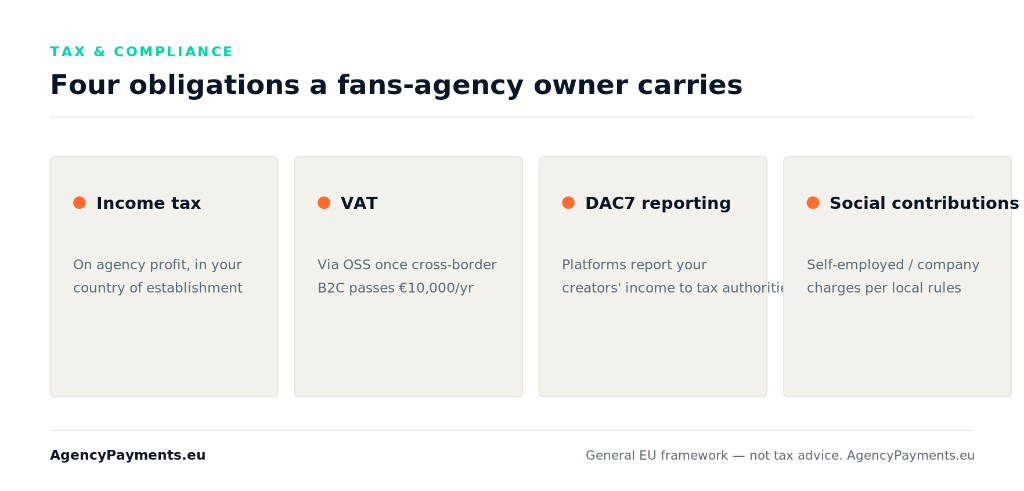
Think of your tax exposure as four separate streams rather than a single "tax bill." They are assessed differently, fall due at different times, and are owed to different parts of the system.
1. Income tax (on your profit)
Your agency pays tax on its profit — revenue minus allowable costs — in the country where the business is established and actually managed. Whether that is personal income tax (sole trader) or corporate tax (company) depends on your legal form. Here is where the main agency jurisdictions stand in 2026:
- Germany. A GmbH carries a combined burden of just under 30% — 15% corporate tax plus solidarity surcharge plus municipal trade tax that varies by town. Relief is legislated but slow: the corporate rate falls one point per year from 2028, bringing the combined burden to roughly 25% by 2032, per the Federal Ministry of Finance. Sole traders instead pay progressive personal rates up to 45%.
- Romania. Standard corporate tax is 16%. The famous micro-enterprise regime still exists but has been cut down hard: from 1 January 2026 the revenue ceiling dropped to €100,000 (it was €250,000 in 2025 and €500,000 before that), with a single 1% rate on revenue, per PwC's Romania summary. Cross the ceiling and you switch to 16% corporate tax from that quarter. A micro-company that was a great vehicle for a mid-sized agency in 2023 now only fits a very small one.
- Spain. The general rate is 25%. Micro-companies under €1 million turnover pay 19% on the first €50,000 of profit and 21% above it in 2026; SMEs between €1 million and €10 million pay 23%, stepping down to 20% by 2029. Genuinely new companies pay 15% for the first two profitable years.
- Poland. 19% standard, or 9% for small taxpayers with revenue up to €2 million. The "Estonian CIT" option (estoński CIT) defers corporate tax entirely until profits are distributed — attractive for agencies reinvesting in growth.
The Tax Foundation's 2026 comparison covers the rest of the map. The practical work is the same everywhere: keep clean books, record every legitimate expense, and set money aside through the year.
2. VAT
VAT is its own world, covered in depth in our VAT framework for fans agencies. In short: the platform generally handles fan-facing VAT after the Fenix ruling, while your concern is the agency-creator supply, where the B2B reverse charge often applies across borders, and the €10,000 threshold plus the One Stop Shop govern any B2C element. VAT is filed separately from income tax and is not optional once you cross the thresholds.
3. DAC7 reporting
Under DAC7, platforms report creator income to EU tax authorities annually once a creator passes €2,000 or 30 transactions a year, and the authorities share it across member states. You don't file DAC7 yourself, but it defines your environment. The first exchanges happened in 2024; by 2026 this is routine, and tax offices run automated matching between platform reports and tax returns. A creator whose platform-reported gross doesn't reconcile with her declared income gets a letter — and if her money flowed through your agency account, the questions come to you next. We cover the mechanics in DAC7 explained.
4. Social contributions
Beyond income tax, every European system levies social-security contributions — on self-employed earnings, on salaries, and sometimes on dividends. This is the stream owners most often forget to budget for. Spanish autónomos pay monthly quotas tied to real income. Polish founders carry ZUS regardless of profit. Romania adds a health contribution on dividend income above certain thresholds. German company directors can be exempt from some branches but not others, depending on shareholding. The pattern: contributions are calculated on different bases than income tax, are owed even in mediocre years, and can rival the income-tax line at moderate profit levels. Get the local numbers before choosing a structure, not after.
Sole Trader or Company?
At small scale, a sole tradership is usually cheaper and simpler: one tax return, no accounting formalities, losses offset other income. The cost is progressive personal rates on everything you earn, full social contributions, and unlimited personal liability — an uncomfortable combination in a chargeback-prone, compliance-heavy industry.
As profit grows, a company usually wins. Corporate rates in the 9–25% range beat top personal rates of 40%+ in most of Europe, liability is contained, and you gain control over when profit reaches you personally. The price is a second layer of tax when you extract the money, plus real accounting obligations. The crossover point differs by country — in Poland the 9% small-taxpayer rate makes the company case early; in Germany the GmbH only pays off once you can afford to leave profit inside it. The mistake is not choosing "wrong" — it is choosing by accident and discovering the consequences at filing time.
Where the Commission Is Taxed — and Why Documented Splits Matter
Your taxable income is your commission, not the creator's gross earnings. That sentence does a lot of work, and it only holds if your records prove it.
If the full platform payout lands in your agency account and you forward the creator's share, two things must be true. First, the payout to the creator must be deductible — which requires a written agreement, an invoice or self-billing document, and a traceable transfer that matches it. Second, the numbers must reconcile with what the platform reported under DAC7. An agency that received €300,000, paid out €210,000 against clean documentation, and declared €90,000 of commission has a boring audit. An agency that received €300,000 and declared €90,000 with nothing connecting the two has just volunteered for a long one — and risks being assessed on the full amount.
This is where payment infrastructure quietly becomes a tax tool. Auto-split arrangements that route the creator's share directly at source keep it off your books entirely, so your accounts show only what is genuinely yours. Our commission calculator shows what that infrastructure costs at different volumes; whatever you use, the principle stands — every euro of creator payout needs a paper trail, because three separate regimes (income tax, DAC7 matching, and AML monitoring) now look at the same flows.
Paying Yourself: Salary or Dividends
Once you run a company, "how much tax do I pay?" splits into two layers: the company's tax on profit, then yours on what you take out.
A salary is deductible for the company but attracts personal income tax and social contributions in full. Dividends come out of already-taxed profit and are taxed again at flat rates: 25% plus solidarity surcharge (26.375% total) in Germany, 19% in Poland, 19–30% on the savings scale in Spain, and 16% in Romania — which doubled its dividend tax from 10% in two steps, reaching 16% for distributions from 1 January 2026. Romania also charges its health contribution on top for resident individuals.
The arithmetic differs sharply by country. A Romanian micro-company under the ceiling pays 1% on revenue plus 16% on dividends — still one of Europe's lightest combinations, though far less generous than two years ago. A German GmbH pays roughly 30% on profit and then 26.375% on the distribution, a combined effective rate near 48% — which is why German owners typically pay themselves a sensible salary first and distribute selectively. Most owners land on a mix; the right mix is a local calculation, not a rule of thumb.
The Reclassification Risk: Chatters and Creators
The tax risk agencies underestimate most in 2026 isn't a rate — it's a status. If your chatters work fixed shifts, follow your scripts, use your accounts and tools, and have no other clients, most European systems will see employees, whatever the contract says. Germany has the sharpest version, Scheinselbstständigkeit: the Deutsche Rentenversicherung's clearing office runs a binding status-determination procedure (Statusfeststellungsverfahren), and reclassification means the agency owes both halves of social contributions retroactively, typically for up to four years, plus wage tax exposure. Other member states run the same logic under different names.
Creator relationships can drift the same way. An exclusive management contract that dictates posting schedules, content, and pricing looks less like agency services and more like dependent work. The defences are structural, not cosmetic: genuine freedom over how work gets done, contractors with multiple clients and their own equipment, no fixed shift rosters — or, where the relationship really is employment, employing people properly and pricing it in. A voluntary status determination before a dispute is far cheaper than an audit after one.
Why "Just Register Somewhere Cheap" Fails
Every agency owner eventually hears the pitch: incorporate in Estonia, Bulgaria, or Dubai and stop worrying. For an owner who stays put in Germany or Spain, it rarely survives contact with three doctrines.
Place of effective management: a company is taxable where it is actually run. An Estonian OÜ managed from a Berlin flat is, in Germany's eyes, a German company — Estonia's 0%-until-distribution regime (22/78 on distributions) helps only people who genuinely operate from Estonia. Substance: treaty benefits and low-tax regimes increasingly require real presence — an office, local decision-making, sometimes staff. CFC rules: under the EU's anti-avoidance directive, low-taxed passive income of a company you control abroad can be attributed straight back to your home country anyway. Add the practical layer — EU banks and EMIs onboarding a fans agency will ask where it actually operates — and the paper-only setup fails on multiple fronts at once. The honest version of tax planning across borders is moving yourself, not just the paperwork.
A Practical Checklist
- Separate the four streams — income tax, VAT, DAC7 visibility, social contributions — and diarise when each falls due.
- Revisit your legal form against 2026 rates; regimes moved (Romania's micro ceiling, Spain's SME cuts, Germany's coming reductions).
- Keep books that cleanly distinguish commission income from the creator share passing through you, with contracts and invoices behind every payout.
- Reconcile your records against what platforms report under DAC7 — before the tax office does.
- Budget social contributions alongside income tax, and model salary-versus-dividend before year-end, not after.
- Review chatter and creator contracts for reclassification risk; fix the working reality, not just the wording.
- Treat any offshore or low-tax structure as guilty until a professional proves substance, management, and CFC rules are all satisfied.
Bottom Line
A fans agency carries four tax obligations at once — income tax on profit, VAT on the right supplies, DAC7 visibility, and social contributions — owed separately and on different schedules. The levers that matter are structural: the right legal form for your country and scale, documented splits that keep creator money off your P&L, a deliberate salary-dividend mix, contractor relationships that survive scrutiny, and a company that is taxed where you actually run it. None of this is exotic. All of it rewards owners who keep clean records and plan ahead — and punishes those still pricing their business as if the income were invisible. It no longer is.
See how tax fits the broader regulatory timeline in our EU compliance calendar for fans agencies.
AgencyPayments.eu is an independent informational resource and does not provide tax advice. Tax rates, structures, and obligations vary by country and change frequently; consult a qualified local accountant or tax adviser. Current as of July 2026.

