
EU IBAN vs Offshore Accounts: Where Should a Fans Agency Hold Funds?
An EU-licensed EMI account and an offshore account can both receive your payouts — but they differ sharply on safeguarding vs deposit insurance, SEPA and IBAN discrimination rules, regulator recourse, and how visible offshore money already is under CRS and DAC7. Here is the full trade-off.
EU IBAN vs Offshore Accounts: Where Should a Fans Agency Hold Funds?
Every fans agency has to keep its money somewhere. Because mainstream banks so often decline the sector, the realistic choice usually comes down to two options: an account with an EU-licensed Electronic Money Institution (EMI) that gives you a European IBAN, or an account with an offshore provider outside the EU.
Both can receive platform payouts. But they are not equivalent, and the differences only become visible at the worst possible moment — when funds are frozen, a regulator asks questions, or a tax authority wants records. This guide breaks down what each option really gives you, so the decision is made deliberately rather than by default.
Safeguarding vs Deposit Insurance: Get This Distinction Right
The most misunderstood part of the EMI model is how your money is protected. It is worth being precise, because the answer is neither "like a bank" nor "not at all."
An EU-licensed EMI is authorised by a European financial regulator — the MFSA in Malta, De Nederlandsche Bank (DNB) in the Netherlands, BaFin in Germany. An EMI is not a bank, and money held with one is not covered by the €100,000 deposit guarantee schemes that protect bank deposits. The Deposit Guarantee Scheme Directive explicitly excludes funds held at e-money and payment institutions. Any provider implying otherwise is misdescribing its own licence.
What EMIs have instead is safeguarding, under Article 7 of the E-Money Directive. The institution must hold client funds separately from its own money — typically in segregated accounts at a credit institution, or invested in secure, low-risk liquid assets, or covered by an insurance policy or comparable guarantee. The practical effect: if the EMI itself fails, safeguarded client money sits outside the insolvency estate. The EMI's creditors cannot touch it; it is returned to clients through the administration process.
So the honest comparison is this. A bank gives you insurance up to €100,000 per depositor. An EU EMI gives you structural segregation with no upper limit — which for an agency holding €200,000 mid-cycle is arguably the more relevant protection — but recovery runs through insolvency administration rather than a fast automatic payout, and it depends on the safeguarding having been done properly, which is exactly what the regulator supervises.
An offshore account offers neither mechanism. Whatever protection exists depends entirely on local law in the provider's jurisdiction, and on your ability to enforce it from Europe.
What an EU IBAN Gives You Day to Day
Protection matters in a crisis. The IBAN itself matters every single day.
Full SEPA access. An EU IBAN plugs you directly into SEPA — the rail your creators, suppliers and tax authorities already use. Since the Instant Payments Regulation took full effect in October 2025, euro-area EMIs must send and receive instant transfers around the clock at no premium over standard transfers, with a free name-check on the recipient (Verification of Payee) before the money moves. Instant euro payouts are now a legal baseline, not a feature.
Legal protection against IBAN discrimination. Under Article 9 of the SEPA Regulation (EU) 260/2012, no business or public body in the EU may insist on a domestic IBAN — a Maltese or Dutch IBAN must be accepted anywhere in the Union for payments and direct debits. In practice, IBAN discrimination still happens — a German platform's payout form rejecting an MT-prefixed IBAN, a payroll system hardcoded to accept only local formats. The difference is that with an EU IBAN this is illegal and fixable: you can escalate to the national competent authority, and companies have been fined for it. With an offshore account there is nothing to escalate — you are simply outside SEPA, and no regulation obliges anyone to pay you there.
Regulatory recourse. If a dispute arises with an EU EMI, there is a named regulator and a defined complaints ladder: first the institution's own complaints procedure, then the external route — the Office of the Arbiter for Financial Services for Malta-licensed EMIs, Kifid or the DNB for Dutch ones, BaFin's complaints procedure in Germany. These routes are free or near-free and produce binding or strongly persuasive outcomes. Offshore, your recourse is whatever the local system offers, pursued remotely, often in a jurisdiction where you have no presence and no leverage.
What "Offshore" Really Means Here
An offshore account is one held with a provider licensed outside the EU. Offshore is not a synonym for illegitimate — several offshore providers are real businesses that have served the adult sector for years, sometimes onboarding clients that EU institutions turn away. But the term describes a specific set of trade-offs.
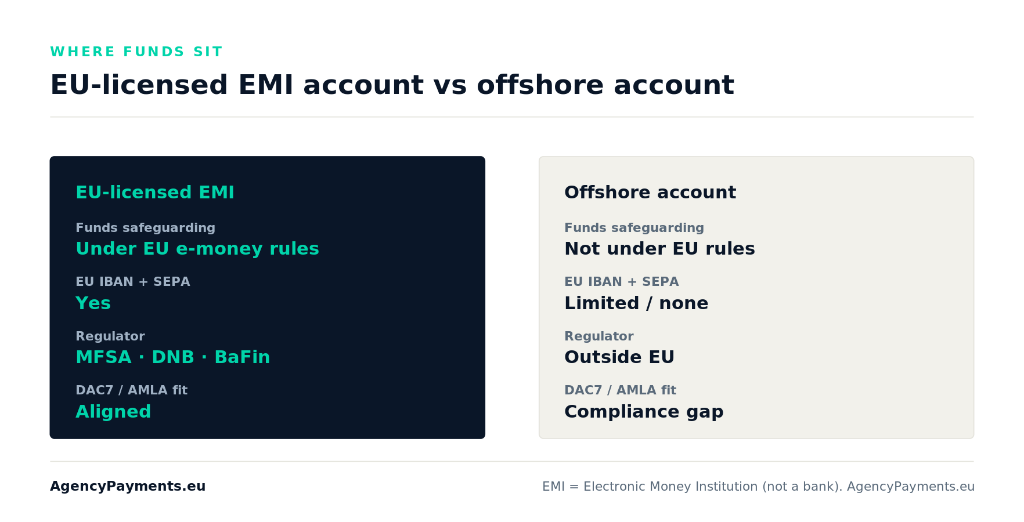
No EU safeguarding. Funds held offshore sit outside the EMD safeguarding regime entirely. Client-money protection, if any, is a matter of local law.
Limited or no SEPA. Without an EU IBAN, transfers typically run on SWIFT or card rails — slower, more expensive, and sometimes routed through non-euro currencies with FX costs on both legs.
Correspondent-banking fragility. Offshore institutions depend on correspondent relationships with larger banks to move major currencies. Those relationships have been shrinking for a decade as global banks de-risk, and small offshore jurisdictions are precisely where they get cut first. When an offshore provider loses a correspondent, its clients' euro and dollar transfers can stall with no warning and no EU regulator to complain to.
Jurisdiction risk on top of provider risk. The EU maintains a list of non-cooperative tax jurisdictions, updated twice a year — the February 2026 revision lists ten jurisdictions, including Panama, Anguilla, Vanuatu and the Turks and Caicos Islands. Payments touching listed jurisdictions attract enhanced scrutiny and, in several member states, punitive tax treatment. Your provider's home address becomes your compliance problem.
The Privacy Argument No Longer Holds
Part of offshore's historical appeal was discretion. That era is over, and it is worth spelling out why.
Under the Common Reporting Standard, financial institutions in more than 100 jurisdictions automatically report account balances and income of foreign tax residents to their home tax authorities every year. Most offshore banking centres participate. An offshore account held by an EU-resident agency owner is, in the normal case, reported to their home tax office annually.
Meanwhile, DAC7 attacks the same question from the platform side: since January 2024, platforms operating in the EU report creator and agency earnings directly to European tax authorities, which now hold more than two years of income data and are actively cross-checking it against declared income. And since January 2026, DAC8 extends the same treatment to crypto — EU-facing crypto providers collect transaction data on all EU-resident users, with first filings to authorities in 2027. We cover the mechanics in DAC7 explained.
The combined effect: your revenue is visible to EU tax authorities at the source, regardless of where the money lands afterwards. Routing it offshore does not reduce what the tax office knows — it just adds a mismatch between reported income and visible accounts, which is precisely the pattern that triggers audits.
The Regulatory Floor Is Rising
The EU's new Anti-Money Laundering Regulation applies directly in all 27 member states from 10 July 2027, replacing the patchwork of national rules with a single rulebook — harmonised customer due diligence, beneficial-ownership transparency, and mandatory enhanced due diligence for high-risk sectors, which includes adult content. AMLA, the new EU-level supervisor in Frankfurt, has been operational since July 2025 and will directly supervise the highest-risk cross-border institutions from 2028. See AMLA 2025 for the full picture.
For agencies, the practical consequence is that every EU-regulated counterparty — platforms, banks, EMIs, accountants — will be asking harder questions about the source and destination of funds. An EU EMI account with clean KYC and traceable SEPA history answers those questions by existing. An offshore account generates them.
The Frozen-Account Angle
The single most disruptive event for an agency is a frozen account mid-cycle, with creators unpaid and funds out of reach. Where your money sits changes how that situation plays out. Inside an EU EMI, there is a regulator, a safeguarding regime, and a defined complaints path with deadlines the institution must meet. Offshore, your options depend on a jurisdiction you may have little leverage in, pursued at your own cost. We cover prevention in detail in why fans agencies get accounts frozen.
Being Honest About the Trade-offs
This isn't a case where one option is simply "good" and the other "bad." Offshore providers sometimes onboard faster, ask fewer questions, or serve operators and niches EU institutions avoid, and for some businesses those factors genuinely carry weight. The point is to price in what you give up: safeguarding, SEPA, recourse, and compliance alignment are not abstractions — they are the things you will wish you had on the day a payout is stuck.
There is also a cost argument that cuts the other way than people expect. Offshore accounts are often assumed to be cheaper because oversight is lighter. In practice, SWIFT fees, correspondent charges, FX spreads on non-euro routing, and the accounting overhead of explaining offshore flows to your own advisers routinely exceed whatever the headline saving was. SEPA transfers inside the EU cost cents; a EUR-to-EUR payment that detours through a Caribbean provider does not.
How This Maps to Providers
Among agency-grade options, the split is clear. EU-licensed EMIs such as Blackcat (regulated by the MFSA in Malta, and a Mastercard Principal Member) and Yoursafe (DNB, Netherlands) provide EU IBANs, full SEPA, and EMD safeguarding of client funds. MAKE operates offshore — licensed via Kappa Investments in the Canary Islands — and while it offers automated splits, it does not provide an EU IBAN or SEPA access. Pricing differs too: Blackcat charges marginal tiers that fall from 1.50% to 0.50% as monthly volume grows, while MAKE charges a flat 1.99% — on €100,000 of monthly volume at a 50% commission split, that works out to roughly €625 versus €995. Among creator wallets, Paxum is registered in Dominica rather than the EU; the Creator Wallet tier as a whole is designed for individual creators and does not offer automated commission splitting. We line these up side by side in how to choose a payment provider for your fans agency and high-risk payment processing for fans agencies.
A Decision Framework
Four questions settle most cases:
- Where do your creators want to be paid? If the answer is European bank accounts in euros — and for EU-based rosters it almost always is — SEPA access is not optional, and only an EU IBAN delivers it natively.
- What happens to your funds if the provider fails? Ask any provider to explain, in writing, how client funds are held. An EU EMI can point to Article 7 safeguarding and a named regulator. Note what an offshore provider points to instead.
- Can you defend the setup in an audit? DAC7 means the tax office already sees your platform income. Your banking should tell the same story your tax filings do.
- Does the arrangement still work in 2028? With AMLR applying from July 2027 and AMLA supervision scaling up, structures that rely on reduced scrutiny have a shelf life. Structures that rely on being boring and traceable do not.
If you answer all four honestly and offshore still wins, you are likely in a genuinely non-EU business — non-EU creators, non-euro flows, no EU nexus. For a European agency, that is rare.
Bottom Line
An offshore account can receive your money. An EU-licensed EMI account receives it and safeguards it under Article 7, connects you to SEPA Instant with legal protection against IBAN discrimination, gives you a regulator and an ombudsman to turn to, and keeps you aligned with DAC7, CRS and the incoming AMLR. For an agency whose whole business depends on paying creators reliably and staying on the right side of European rules, the EU IBAN is the option built for the direction regulation is heading — and regulation is only heading one way.
Compare providers for your own volume and commission setup in our free calculator.
AgencyPayments.eu is an independent informational resource. We are not affiliated with any payment provider mentioned. "EMI" refers to an Electronic Money Institution, which is not a bank; EMI funds are safeguarded, not covered by deposit guarantee schemes. Details are current as of July 2026 and may change.

