
The Creator-Economy Payment Stack: How Agency Money Flows in Europe
Money in the creator economy makes six hops before it reaches a creator — from the fan's card through the platform, the payout account, and the agency split. Mapping the full flow, with fees, timing, and the regulation at each hop, explains almost every payment problem a European fans agency runs into.
The Creator-Economy Payment Stack: How Agency Money Flows in Europe
A fan taps "subscribe" in Berlin. Some weeks later, a creator in Lisbon sees her net share land on her card, and the agency managing her account has banked its commission somewhere in between. It looks like one payment. It is actually six hops across four layers, each with its own fees, its own timing, and its own regulator watching.
Most payment problems a fans agency runs into — frozen accounts, VAT confusion, manual-split headaches, offshore risk — get easier to understand once you can see the whole system. This guide maps it end to end: what happens at each hop, what it costs, how long it takes, and where European rules touch the money. Treat it as the orientation map for everything else on this site.
The Market Moving Through These Rails
The scale is worth pausing on. Goldman Sachs Research put the creator economy's addressable market at roughly $250 billion and projected close to $480 billion by 2027, with around 50 million people worldwide earning as creators — SignalFire's count finds only about two million of them doing it full-time.
For fans agencies, the reference platform remains OnlyFans, and its numbers are audited. Fenix International's FY2024 accounts, filed at Companies House in late 2025, show $7.22 billion in gross fan payments (up 9%), roughly $5.8 billion paid out to creators after the platform's 20% fee, and $1.41 billion retained as net revenue — across 4.6 million creator accounts and 377 million fan accounts. Every one of those dollars crossed the stack described below.
Two things follow from those numbers. First, the average creator account earned far less than the headlines suggest — which is precisely why agencies exist: professional management concentrates earnings, and concentrated earnings need professional payment plumbing. Second, roughly four out of every five dollars a fan spends eventually has to travel the lower half of the stack, from platform payout to creator account. That lower half is where European agencies operate.
Four Layers, Six Hops
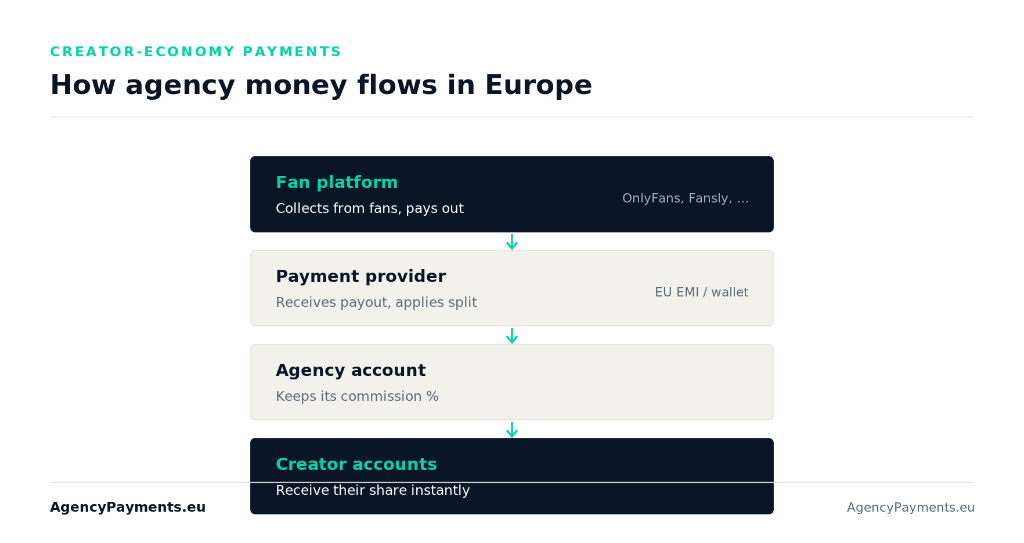
The four layers — platform, provider, agency, creator — are the map. The six hops are the territory. Here is what actually happens at each one.
Hop 1 — Fan's card to the platform's acquirer
The fan's payment is a card-not-present transaction routed to the platform's acquiring bank. This hop is governed by card-scheme rules: adult platforms process under high-risk merchant categories, carry scheme registration fees, and live under strict chargeback thresholds — the pressure behind OnlyFans' near-ban of explicit content in 2021 came from exactly this layer. For EU fans, Strong Customer Authentication under PSD2 means a 3-D Secure challenge on most payments; PSD3 and the PSR, politically agreed in November 2025 and expected in the Official Journal around mid-2026, will tighten fraud rules further from roughly late 2027.
For the fan, authorisation is instant. Fees at this hop — interchange, scheme fees, the acquirer's high-risk margin — are the platform's cost, invisible to creators and agencies but baked into the 20% the platform keeps.
Hop 2 — Acquirer to platform
The acquirer settles card takings to the platform in batches, usually within days, often minus a rolling reserve held against chargebacks. This is also where the fan-facing tax sits: after the Fenix ruling (CJEU, February 2023), a platform that intervenes in supplying digital content to consumers is deemed the supplier and accounts for VAT on the full amount the fan pays, at the fan's local rate. The creator's balance is credited net of that VAT and the platform fee, then typically held for a short buffer period before it becomes withdrawable. (See VAT for fans agencies.)
Hop 3 — Platform payout
The creator's 80% — the same headline split at OnlyFans and Fansly, while Fanvue takes 15% for a creator's first year, then 20% — leaves the platform on request or on a schedule. For European creators the realistic menu is: SEPA credit transfer (typically one to two business days), international wire (OnlyFans charges $30 per transfer), or sector e-wallets such as Paxum, often faster but with per-transaction limits. OnlyFans' minimum payout is $20.
Two compliance checkpoints sit on this hop. First, DAC7: since January 2024, platforms report each EU creator's annual earnings to tax authorities once they pass €2,000 or 30 transactions a year — authorities now hold two-plus years of this data and are actively cross-checking it against filings. Second, the platform's own KYC: payouts only flow to verified identities and accounts. (See DAC7 explained.)
Hop 4 — The landing account
The payout has to land somewhere, and this is where most agency pain originates. Mainstream providers — Stripe, PayPal, high-street banks — routinely decline or freeze fans-economy businesses under card-network and internal-policy pressure. AML and KYC obligations bite at this layer: the account provider must know its customer, monitor flows, and, for high-risk sectors under the incoming AMLR (applying from July 2027, with AMLA in Frankfurt already operational), apply enhanced due diligence as standard. An account that wasn't opened with full disclosure of the business model is an account waiting to be frozen.
The realistic options are specialised: EU-licensed EMIs with safeguarded funds and real IBANs, or wallets and offshore providers that accept the sector at the cost of traceability. (See high-risk payment processing, why accounts get frozen, and EU IBAN vs offshore accounts.)
Hop 5 — The agency split
Now the agency takes its agreed commission and passes the rest on. The critical question is how. Manually — someone calculates each creator's share, initiates each transfer, reconciles each month — or automatically, where the provider splits every incoming payment by configured percentages the moment it arrives. At five creators the difference is an evening of admin. At thirty it is the difference between an agency that scales and one that drowns. (See how automated split payments work and scaling payment operations.)
Hop 6 — The creator's net share
The final leg usually runs over SEPA, and SEPA changed in 2025. Under the Instant Payments Regulation (EU) 2024/886, eurozone providers — banks, EMIs and payment institutions alike — have been required to receive instant euro transfers since January 2025 and to send them since 9 October 2025, at no premium over standard transfers. Settlement in ten seconds, around the clock. Verification of Payee, mandatory since the same October date, checks the recipient's name against the IBAN before the money moves — a free, built-in defence against payout typos and redirection fraud. Instant is now the legal baseline, not a feature. (See SEPA Instant vs SEPA Credit Transfer.)
The clock, end to end
Add the hops up and the timeline becomes concrete. A fan's payment authorises in seconds on day zero. The acquirer settles to the platform over the following days, and the platform holds the creator's share through its clearing buffer — commonly around a week — before it becomes withdrawable. The payout itself then takes one to two business days over standard SEPA, or less via e-wallet. In an automated-split setup, the split and the creator's instant transfer add seconds, not days. In a manual setup, the creator waits for whenever the agency next runs payouts — which is why "when do I get paid?" is the most common message an unautomated agency receives.
The crypto detour
Some flows still exit through crypto at hop 5 or 6. That route now runs through a fully regulated corridor: MiCA's transitional period ended on 1 July 2026, so any exchange or custodian serving EU users must hold a MiCA licence — around 220 had one by mid-2026, and unlicensed venues are exiting or blocking EU customers. DAC8 has CASPs collecting data on all EU-resident users' transactions since January 2026, with first filings to tax authorities in 2027, and the travel rule attaches sender and recipient data to transfers. Crypto payouts remain possible; invisible ones do not. (See MiCA and crypto payouts and crypto vs SEPA.)
The Two Payout-Account Architectures
Hops 4 through 6 can be wired in two fundamentally different ways, and the choice defines an agency's payment operations.
Architecture A: agency-grade with automated splits. The platform pays into an account at an EU-licensed EMI that supports split payments. The provider divides every incoming payout by configured percentages — commission to the agency's account, net share to each creator's — and forwards the creator legs over SEPA Instant, often onto cards the provider itself issues. One incoming payment, an auditable split record, zero manual transfers. Providers in this tier differ meaningfully: split limits vary (one caps splits at 50%, another doesn't publish a limit), regulatory homes vary from EU EMI licences to offshore structures, and pricing runs from marginal tiers starting at 1.5% and falling to 0.5% at volume, to flat rates around 2%. On €100,000 of monthly platform payouts, that pricing difference alone is already a few hundred euros a month. (See the full comparison of Blackcat, MAKE and Yoursafe.)
Architecture B: creator wallets with manual commission. Each creator receives their full payout into an individual wallet — Paxum, CosmoPayment, Capitalist — and the agency collects its commission afterwards, by invoicing the creator or having them forward it. These products are designed for individual creators, and for a solo creator they do that job well. For an agency, the commission leg becomes a monthly cycle of requests, reminders and reconciliation that grows linearly with the roster — and the agency never has provider-level visibility of the money it is owed. (See creator wallets compared.)
There is a tax dimension too: in either architecture, the agency's commission is a B2B service to the creator, generally reverse-charged across EU borders — separate from the fan-facing VAT the platform already handled at hop 2.
Why the Last Leg Is Where You Actually Have Choices
Notice what an agency controls. Hops 1 and 2 belong to the platform and its acquirer — no agency negotiates interchange or scheme registration. Hop 3 offers a narrow menu the platform defines. But hops 4 to 6 — where the money lands, how it splits, which rail carries the creator's share — are entirely the agency's decision. That is why this site spends most of its energy there: the last leg is the only part of the stack where a European fans agency can materially change its costs, its speed, and its risk.
Where the Stack Breaks
Read top to bottom, the failure points are predictable:
- Hop 4 rejection. A mainstream provider refuses or freezes the business — the most common and most disruptive failure.
- Hop 5 manual splits. The agency divides money by hand and the process collapses as the roster grows.
- Cross-hop compliance gaps. DAC7 data lands with the tax office whether or not the agency's books agree with it; an untraceable choice at hop 4 or a non-compliant crypto detour surfaces as a problem at tax time. The obligations arrive on a schedule — see the EU compliance calendar.
Almost every "payment problem" an agency describes maps to one of these.
Bottom Line
Six hops: fan's card to acquirer, acquirer to platform, platform payout, landing account, agency split, creator's net share. The platform owns the first three; the agency owns the last three. Card-scheme rules govern the top of the stack, DAC7 watches the platform payout, AML and KYC guard the account layer, Verification of Payee and ten-second settlement now define the SEPA leg, and MiCA plus DAC8 police the crypto detour. Seen this way, the common problems stop looking like bad luck and start looking like predictable failures at specific hops — each with a known fix.
See what the last leg costs under each architecture in our free calculator, or read how to choose a payment provider for your fans agency.
AgencyPayments.eu is an independent informational resource. We are not affiliated with any platform or payment provider mentioned. Current as of July 2026.

