
Why Fans Agencies Get Their Accounts Frozen — And How to Prevent It
Account freezes are the biggest operational risk for fans agencies. Learn why they happen, the five most common scenarios, and the practical steps to prevent them.
If you run a fans agency, you already know the fear. One morning you log in to your payment provider and everything is locked. Balance frozen. Withdrawals disabled. No clear explanation. No timeline for resolution.
This happens more often than the industry admits. And it is almost always preventable.
Account freezes are not random. They follow predictable patterns — patterns that agency owners can recognise and avoid if they understand why providers freeze accounts in the first place. This guide explains the root causes, the most common scenarios, the real damage a freeze causes, and the practical steps you can take to protect your agency.
Why Payment Providers Freeze Agency Accounts
The adult content industry is classified as "high-risk" by payment processors, card networks, and financial regulators. This classification exists because of historically high chargeback rates, regulatory complexity across jurisdictions, and reputational concerns that many financial institutions prefer to avoid entirely.
Most payment providers are not built for this industry. They will accept your application, process your first few transactions, and then react when their compliance team notices an inbound transfer from Fenix International Limited — the UK-based company that operates OnlyFans. The compliance team does not know what your business does. They see a flagged entity, a high-risk industry code, and they freeze the account while they investigate.
This is not malice. It is a systemic mismatch: you are using infrastructure that was not designed for your business.
Beyond the initial industry flag, there are specific triggers that cause freezes. Large transaction volumes arriving suddenly — for example, when you onboard several new models at once — can trigger automated anti-money laundering reviews. Multiple beneficiaries receiving funds from the same source looks like structuring to compliance systems. Cross-border transfers, particularly from UK-based platforms to EU accounts, add another layer of scrutiny.
None of these triggers require you to have done anything wrong. The system flags patterns, not intent.
The Most Common Scenarios
Agency owners encounter account freezes in predictable situations. Understanding these scenarios is the first step to avoiding them.
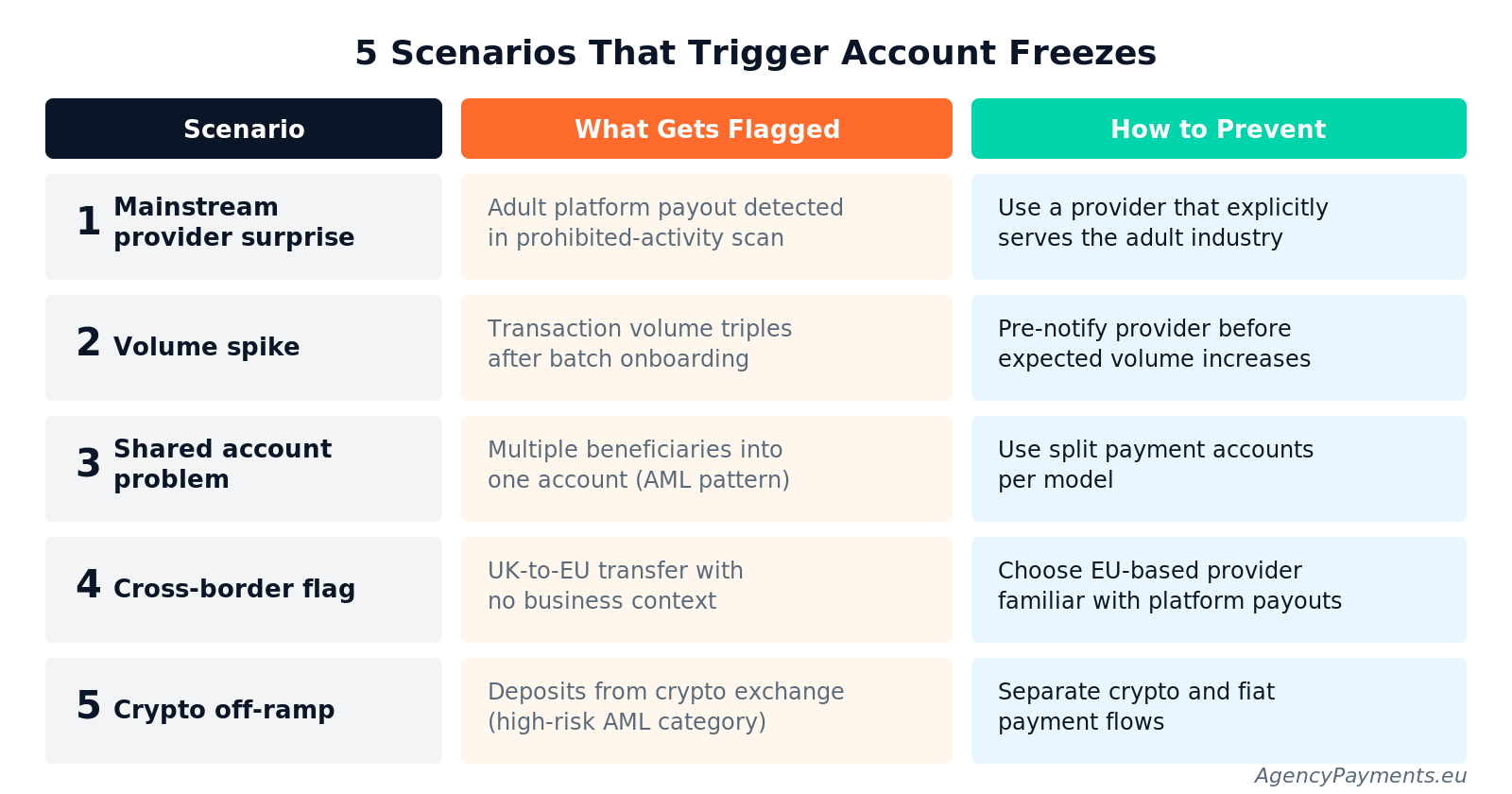
Scenario one: the mainstream provider surprise. You open an account with a well-known payment provider — one that is popular, easy to set up, and works for most businesses. Your first payout from OnlyFans arrives. Within days, the account is frozen. The provider's terms of service include a clause about "prohibited activities" that covers adult content, or their compliance team flags the inbound transfer from a known adult platform. You never checked because the provider never asked.
Scenario two: the volume spike. Your agency has been operating smoothly for months with five models. You sign ten new creators in a single month. Transaction volume triples. The provider's automated monitoring system flags the sudden increase as suspicious activity. Your account is frozen pending a compliance review — which takes four to eight weeks because the provider's compliance team has no experience with the adult content industry and does not know how to assess your documentation.
Scenario three: the shared account problem. Multiple models' payouts are flowing into a single agency account. To the compliance system, this looks like funds from multiple unrelated sources being aggregated into one account — a pattern associated with money laundering. The fact that you have contracts with each model does not matter until someone asks for them, and that only happens after the freeze.
Scenario four: the cross-border flag. Your agency is based in Romania or Germany. Your models receive payouts from OnlyFans, which are sent by Fenix International, a UK company. Post-Brexit, UK-to-EU transfers receive additional scrutiny. The transfer narrative mentions nothing about the nature of the business. The compliance team flags it for review.
Scenario five: the crypto off-ramp. Your agency or your models convert platform earnings to cryptocurrency, then convert back to EUR through an exchange. The provider sees deposits from a crypto exchange and freezes the account — because crypto-to-fiat flows are among the highest-risk transaction types for AML compliance.
Each of these scenarios is preventable. None of them require you to have broken any law.
What Happens When Your Account Gets Frozen
The immediate damage is financial. Your funds are locked — sometimes for weeks, sometimes for months. You cannot pay your models their share. You cannot meet your own business obligations: office rent, staff salaries, software subscriptions, advertising spend.
But the secondary damage is worse.
Models who do not get paid on time leave. They do not wait for your compliance review to resolve. They move to another agency — one that can pay them reliably. The models you spent months recruiting and onboarding are gone, and they are telling other models about their experience.
During the freeze, you are typically required to provide extensive documentation: company registration certificates, contracts with every model, explanations for specific transactions, source of funds declarations, proof of business activity. If you do not have this documentation organised and ready, the review takes even longer.
Some providers ultimately close the account permanently. They return your funds — minus administrative fees — and terminate the relationship. You are now flagged in internal industry databases, which can make opening accounts with other mainstream providers more difficult.
The total cost of an account freeze is not just the frozen balance. It is lost models, lost revenue, lost time, and damaged reputation in a market where trust is everything.
Why Mainstream Providers Do Not Work for This Industry
Most traditional financial institutions in Europe will not knowingly maintain accounts for adult content businesses. Some will onboard you — particularly if your company registration documents do not explicitly mention adult content — but they will exit you when they discover the nature of your business. This is not a question of if, but when.
General-purpose fintech payment apps present a similar problem. Their acceptable use policies typically exclude adult content, adult entertainment, or "sexually explicit material." Even when the terms are ambiguous, the provider's compliance team will interpret them conservatively when they see transactions from known adult platforms.
There is also a category of providers that technically allow adult content but lack the internal processes to handle it. Their compliance systems flag adult-related transactions the same way they flag any other high-risk activity, and their compliance teams have no specialised knowledge of the industry. The result is the same: freezes, delays, and eventual account closure.
The fundamental issue is that these providers assess adult content businesses using the same risk frameworks they use for every other client. They do not have the context to distinguish between a legitimate, contract-based agency operation and a suspicious financial flow. Without that context, they default to freezing first and asking questions later.
How to Prevent Account Freezes
Account freezes are preventable. Here is what works.
Use a provider that explicitly serves the adult content industry. This is the single most important decision. Before onboarding, ask the provider directly: do you work with fans agencies? How many do you currently serve? Have you ever frozen an agency account, and if so, why? A provider that actively serves this vertical has compliance processes designed for it. They know what OnlyFans payouts look like. They will not panic when they see them.
Choose a licensed EU payment provider. Look for an Electronic Money Institution (EMI) authorised by an EU financial regulator. Licensed providers operate under clear regulatory frameworks, follow fund safeguarding rules, and have defined processes for compliance reviews. If something goes wrong, you have recourse through the regulator. With an unlicensed or offshore provider, you may have no recourse at all.
Separate agency and model accounts properly. Do not aggregate multiple models' earnings into a single account. Use a provider that issues individual accounts to each model, with automated splits routing the agency's commission separately. This eliminates the AML pattern that triggers scenario three above, and it is the correct operational structure for a compliant agency.
Maintain documentation before you need it. Have your company registration, articles of association, and tax registration readily available. Maintain signed contracts with every model you work with. Keep records of your source of funds. When a compliance review happens — and it will happen at some point — the agencies that resolve it quickly are the ones that can produce documents immediately.
Pre-notify your provider of significant volume changes. If you are about to onboard ten new models, tell your provider before the volume spike appears. A quick email to your account manager — explaining that you expect transaction volume to increase by a certain amount over the next month — provides the context that prevents an automated freeze from escalating to a full compliance review.
Have a backup payment route. No single provider should be your only option for paying your models. Maintain accounts with at least two industry-appropriate providers. If one account is frozen, you can continue operating while the review resolves. This is not redundancy for its own sake — it is basic operational resilience for a business operating in a high-risk category.
What to Do If Your Account Is Already Frozen
If you are reading this because your account is frozen right now, here is the practical sequence.
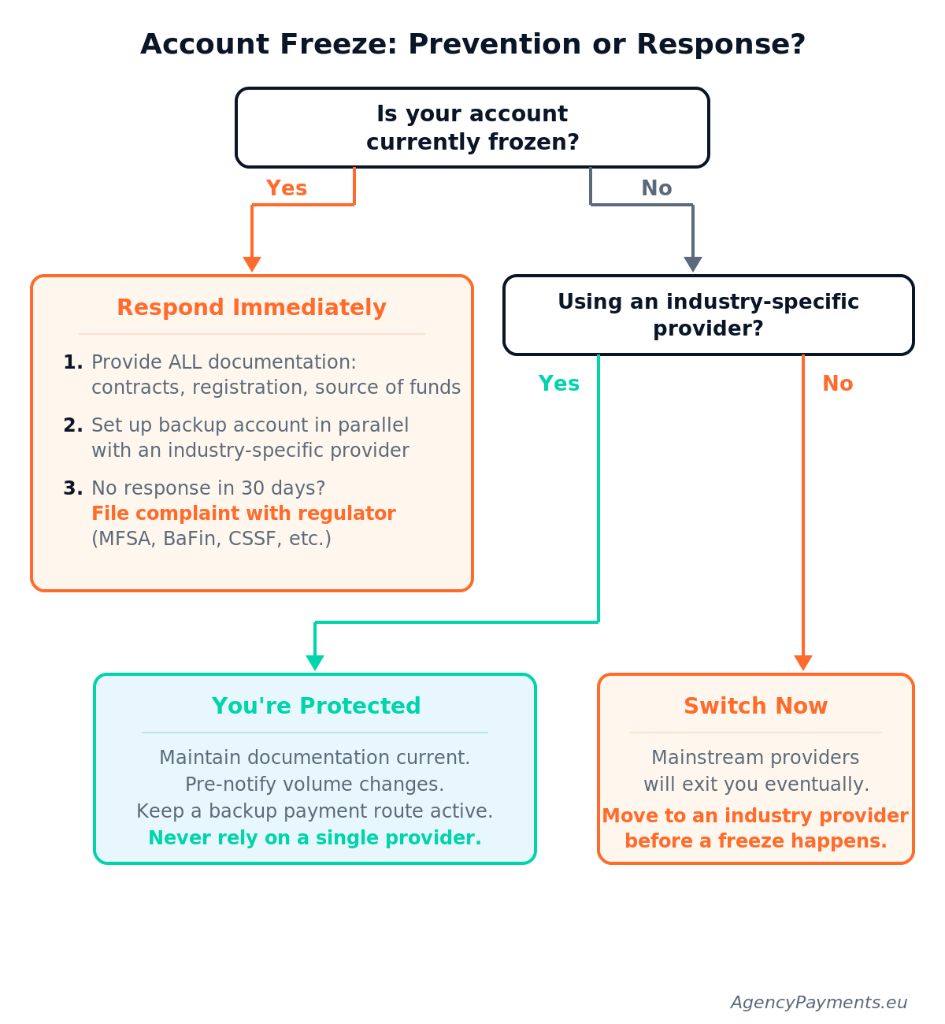
Respond immediately and completely. Do not wait for the provider to specify exactly what they need. Send everything: company registration, model contracts, source of funds explanation, transaction narrative for any flagged payments. Providers resolve reviews faster when they receive complete documentation upfront rather than in partial batches over several weeks.
Escalate in writing. Document every communication. If you have an account manager, contact them directly. If not, use the provider's formal complaints process — not the general support chat. Written escalation creates a paper trail and typically gets faster responses than informal channels.
Set up a backup account immediately. While the review is ongoing, open an account with an industry-appropriate provider. You cannot wait for the review to resolve before establishing your backup. Your models need to be paid, and you need an operational payment route.
Know your regulatory rights. EU-licensed EMIs are required to follow defined processes for account restrictions. They must provide reasons for account closure within a reasonable timeframe, and they must return your funds. If a licensed provider is holding your funds beyond a reasonable period without explanation, you have the right to complain to the relevant financial regulator — the MFSA in Malta, BaFin in Germany, DNB in the Netherlands, depending on where the EMI is licensed.
Do not use an offshore or unlicensed provider as your primary account. If your account is frozen at an unlicensed provider, your regulatory recourse is limited. This is the lesson that makes the prevention steps above worth taking seriously.
The Provider Selection Question
Every account freeze analysis ends in the same place: the providers that serve fans agencies well are the ones built for this vertical from the start.
Blackcat, licensed by the MFSA in Malta as an EMI and a Mastercard Principal Member, is built specifically for agencies managing multiple creators. Their account architecture includes automated commission splits as a core feature — not an add-on. Incoming funds are automatically divided between the agency's account and individual model accounts at the configured percentage, without manual intervention.
Yoursafe, authorised by the DNB in the Netherlands, offers a similar structure with EU IBAN accounts and SEPA transfers. Their compliance processes are designed for high-risk merchants, which means they understand what fan platform payouts look like and do not flag them as suspicious.
Both providers operate under EU financial regulation, which means your funds are safeguarded and you have clear recourse if something goes wrong.
The comparison that matters is not Paxum versus Blackcat on fee percentage. It is: which infrastructure lets your agency operate without the existential risk of a compliance freeze shutting down your cash flow for a month?
Summary
Account freezes happen to fans agencies because most payment infrastructure was not built for this industry. The triggers are predictable: mainstream providers flagging adult platform payouts, volume spikes without pre-notification, aggregated funds that look like AML patterns, cross-border transfers without context, and crypto flows that trigger automatic review.
The prevention is equally predictable: use an industry-appropriate licensed EU provider, separate your accounts properly, maintain documentation, communicate volume changes in advance, and keep a backup payment route active.
If your account is already frozen, respond completely and immediately, escalate in writing, open a backup account now, and understand your regulatory rights under EU financial law.
The agencies that do not get frozen are not doing anything different operationally. They have just chosen infrastructure that was built for their business.

