
MiCA and Crypto Payouts: What Already Changed and What Hits on July 1
191 crypto-asset service providers are already MiCA-authorized. After July 1, those without authorization must cease EU operations.
MiCA and Crypto Payouts: What Already Changed and What Hits on July 1
191 crypto-asset service providers are already MiCA-authorized. After July 1, those without authorization must cease EU operations.
You run 15 models through a fans agency in Kraków and pay them partly in crypto via Manerio, the crypto layer in your Blackcat account. You've seen "MiCA" in fintech newsletters for a year. You've ignored it — it seemed like a problem for exchanges, not for you. It is a problem for you. Not because MiCA regulates your agency — it doesn't. But it regulates the provider that moves your crypto. If that provider isn't licensed by July 1, 2026, your payout infrastructure breaks. Here's what already happened, and what to verify before July 1, 2026.
MiCA in Two Minutes — What It Is and What It Already Changed
MiCA — the Markets in Crypto-Assets Regulation — is the EU's first comprehensive framework for crypto assets. It covers all 27 member states with a single rulebook: licensing for crypto-asset service providers (CASPs), reserve requirements for stablecoin issuers, and consumer protections for anyone using crypto services within the EU.
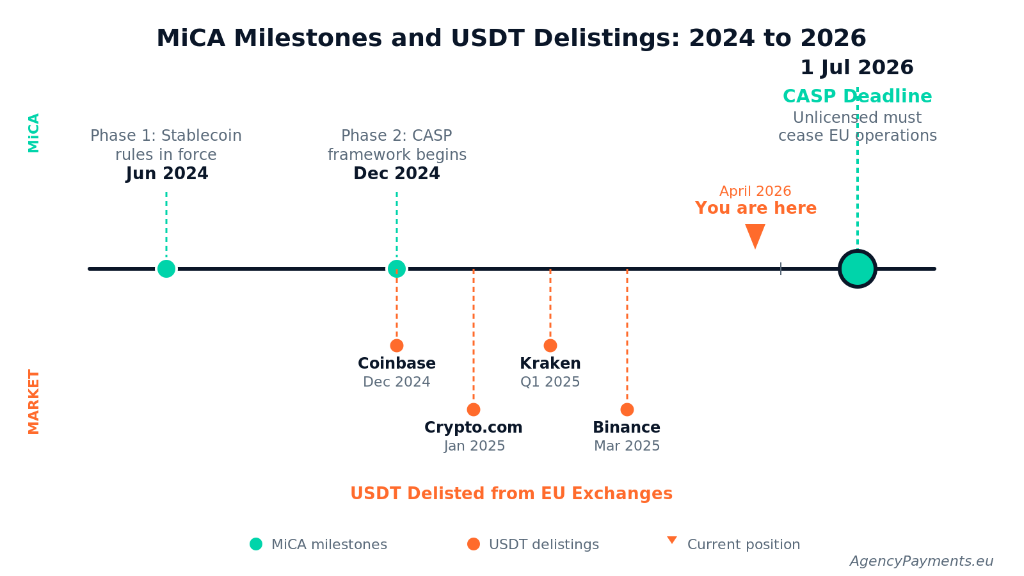
MiCA rolled out in two phases. Phase 1, covering stablecoin regulation (asset-referenced tokens and e-money tokens), took effect in June 2024. Phase 2, covering CASP licensing and operations, went live in December 2024. Both phases are now fully in force.
The industry has responded. As of 3 April 2026, the ESMA interim register lists 191 authorized CASPs across the EU. Germany leads with 55 authorizations, followed by the Netherlands (25), France (13), Malta (12), and Cyprus (12). These providers can legally serve clients across all 27 member states through passporting.
What changed on the ground? Before MiCA, any company could offer crypto services to EU clients with minimal regulatory friction. National frameworks varied wildly — a provider registered in Estonia operated under different rules than one in Germany. MiCA replaces that patchwork with uniform requirements: minimum capital, governance standards, IT security baselines, client asset segregation, and mandatory complaint-handling procedures. Providers that meet the bar get authorized. Those that don't, exit.
For fans agencies, MiCA doesn't create new obligations for you directly. It regulates the providers you use. But the practical effect is the same: if your crypto provider isn't authorized, you lose the service. And that cutoff is no longer hypothetical — it already happened to the stablecoin your provider might be paying you in.
The USDT Exodus — What Happened in 2024–2025
MiCA classifies stablecoins pegged to fiat currency as e-money tokens (EMTs). To issue an EMT within the EU, you need authorization as an electronic money institution — plus specific reserve requirements, including holding at least 60% of reserves in EU credit institution deposits.
Circle, the issuer of USDC, obtained a French EMI license and restructured its European reserves to meet MiCA requirements. USDC is MiCA-compliant. It trades freely on EU-regulated exchanges.
Tether, the issuer of USDT, has not obtained EU EMI authorization. Multiple major exchanges — including Coinbase Europe and Bitstamp — delisted USDT for EU users during 2024 and 2025. The delistings weren't coordinated bans. Each exchange independently concluded that offering a non-compliant EMT to EU customers created regulatory risk they weren't willing to carry.
The result: a quiet but industry-wide migration from USDT to USDC across EU-facing crypto operations. This isn't a future scenario — it's a completed shift for regulated platforms. USDC's EU market share has grown steadily as USDT liquidity drains from compliant exchanges.
The USDT situation is worth understanding because it illustrates how MiCA works in practice. The regulation didn't ban USDT. It set requirements that USDT's issuer hasn't met. The market — exchanges, payment providers, institutional users — drew its own conclusions. The same dynamic will play out for CASPs after July 1: MiCA doesn't shut anyone down directly, but operating without authorization becomes commercially and legally untenable.
What this means for your agency: if your crypto payouts arrive in USDT, ask your provider two questions. First, are they switching to a compliant stablecoin? Second, what's their timeline? The longer you wait, the fewer options you have if the answer is "we haven't decided yet."
For a broader operational comparison of crypto and fiat payouts, see our comparison of crypto vs SEPA for agency payouts.
The July 1 Deadline — What Happens Next
MiCA gave existing crypto providers a grace period. Under Article 143's transitional provisions, CASPs already operating before December 30, 2024 could continue serving EU clients while their authorization applications were processed. That grandfathering window closes on July 1, 2026. No extensions have been announced.
After July 1, unlicensed CASPs must cease operations with EU clients. "Cease operations" means exactly what it sounds like: stop onboarding new EU users, execute wind-down plans for existing accounts, transfer client assets to licensed providers or return them, and notify affected users.
The penalties for non-compliance are material. National competent authorities can impose fines of up to €5 million or 5% of the provider's annual turnover — whichever is higher. For providers operating without authorization after the deadline, these aren't theoretical threats. ESMA has explicitly stated that the transitional period will not be extended and that enforcement will follow.
The 191 CASPs already on the ESMA register will continue operating normally. They've completed the authorization process and meet MiCA's requirements for capital, governance, IT security, and client asset safeguarding. For their clients, July 1 changes nothing.
For clients of unlicensed providers, July 1 changes everything. And the disruption may not arrive as a sudden shutdown — some providers may start restricting services, reducing withdrawal options, or limiting new transactions in the weeks before the deadline as they execute wind-down plans. The time to verify is now, not when you notice your payout failing.
Is Your Crypto Provider MiCA-Authorized?
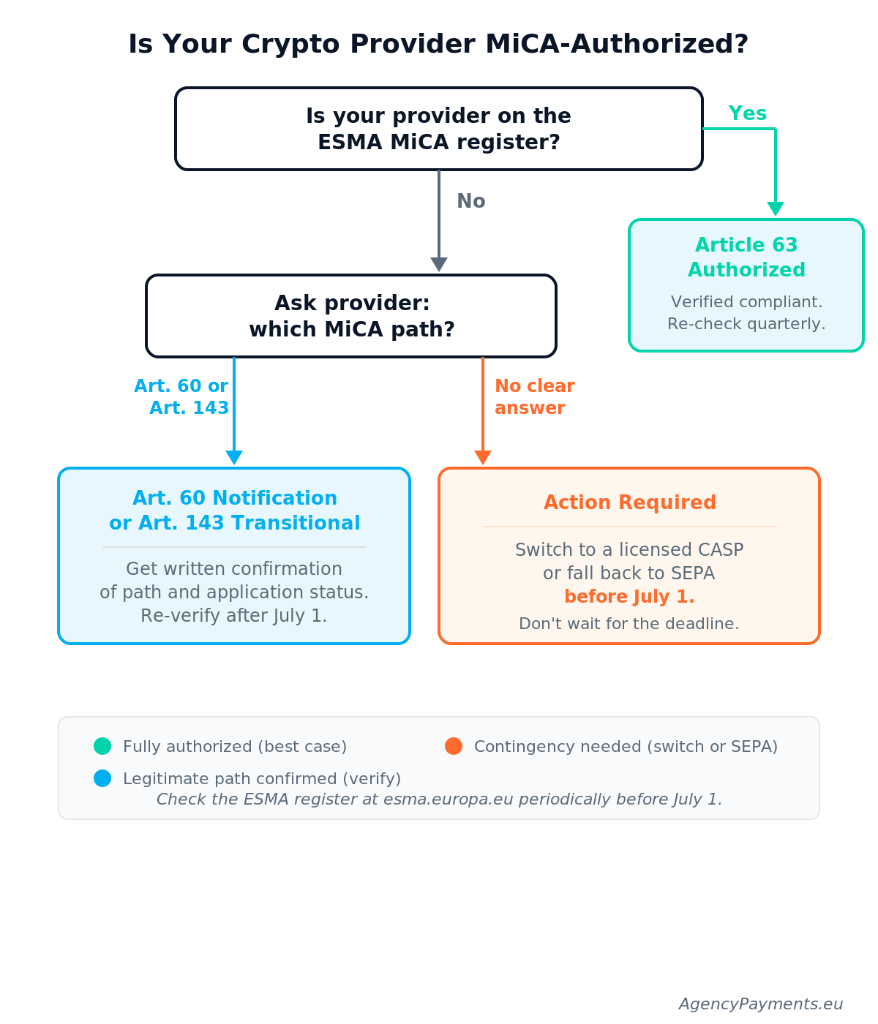
ESMA maintains a public register of authorized CASPs. The register is updated weekly — check it periodically before relying on a provider's claimed status. A CASP authorized in any single EU member state can serve clients across all 27 through passporting, so the country of authorization doesn't limit your access.
A provider not appearing in the CASP register doesn't automatically mean it's operating illegally. MiCA provides three legitimate paths beyond Article 63 full CASP authorization:
- Article 143 transitional regime: entities that provided crypto-asset services before 30 December 2024 can continue operating under their national pre-MiCA framework until 1 July 2026 — the deadline this article is about. This is temporary.
- Article 60 notification: already-authorized financial institutions (EMIs, credit institutions, investment firms) can offer specific crypto-asset services through notification rather than full CASP authorization, if those services fall within deemed equivalence. This is a permanent mechanism, not a transitional one.
- Out of scope: some limited custody or transfer functions may not qualify as "crypto-asset services" under MiCA's specific definitions.
If your provider isn't in the public CASP register, ask them directly which path they operate under. Don't assume non-compliance — but also don't assume everything is fine without an answer.
For the fans-agency ecosystem, two providers offer crypto payouts. Neither has publicly confirmed MiCA/CASP authorization status as of this writing.
Blackcat / Manerio
Blackcat is regulated as an EMI by the MFSA (Malta). Manerio is the crypto payout layer integrated into Blackcat's product. The exact legal arrangement between Blackcat and Manerio — and which MiCA path applies — is not publicly disclosed. If Manerio operates as part of Blackcat's EMI entity (Papaya Ltd), the Article 60 notification path for authorized financial institutions may be relevant. If Manerio is a separate legal entity providing crypto-asset services, full CASP authorization under Article 63 applies. Ask Blackcat directly: is Manerio MiCA-authorized under Article 63, or operating under Article 60 as part of Papaya Ltd's EMI license?
MAKE Payments
MAKE is incorporated in Seychelles and operates as an offshore payments provider. It does not hold an EU license. If MAKE facilitates crypto-asset services for EU clients, it falls under MiCA's CASP requirements with no Article 60 pathway available — that pathway requires pre-existing EU authorization as a financial institution. MAKE's eligibility for the Article 143 transitional regime depends on whether it was actively offering crypto services to EU clients before December 30, 2024. Verify MAKE's status directly before July 1.
What to Do Before July 1
Check the ESMA register. Search for your provider at the ESMA CASP register. If they're listed, you're fine.
Ask your provider directly. If they're not listed, ask: are you operating under Article 143 transitional regime, Article 60 notification, or have you applied for Article 63 authorization? Get a written answer.
Verify stablecoin compliance. If you receive USDT, ask when your provider is switching to a MiCA-compliant stablecoin. If the answer is vague, plan for disruption.
Identify a backup. Know which MiCA-authorized providers can replace your current crypto payout infrastructure if needed. The 191 authorized CASPs include providers offering payment services — the market exists.
Set a calendar reminder. July 1 is the hard deadline. If your provider hasn't resolved their status by mid-June, start the migration before the deadline forces it.
The MiCA transition isn't a distant regulatory abstraction. It's a concrete operational deadline with a public register you can check today. Do that check before July 1.

