
SEPA Instant vs SEPA Credit Transfer: Which Rail Should Pay Your Creators?
Standard SEPA settles next business day; SEPA Instant settles in ten seconds, around the clock. What the Instant Payments Regulation, Verification of Payee and the 2027 deadline mean for a fans agency paying creators.
SEPA Instant vs SEPA Credit Transfer: Which Rail Should Pay Your Creators?
For a European fans agency, "getting paid" and "paying creators" both run over the same plumbing: SEPA, the Single Euro Payments Area. Most agencies never think about which SEPA rail they are using — until a creator messages on a Friday night asking where their money is, and the answer is "Monday, when the banks open."
There are two SEPA rails for euro transfers, and the difference between them has stopped being a technical footnote. Since October 2025, every eurozone payment provider must be able to send instant transfers, every euro transfer is preceded by a name check called Verification of Payee, and sanctions screening has been redesigned so it no longer slows individual payments down. This guide explains how the two rails differ, what the Instant Payments Regulation has changed in practice, and what it all means for an agency that distributes money to creators every week.
The Two SEPA Rails
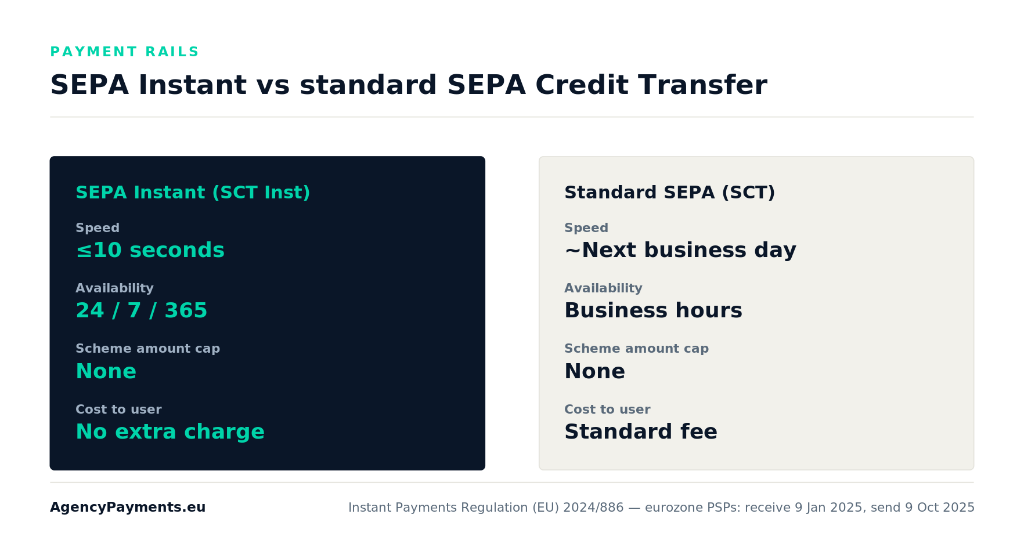
SEPA Credit Transfer (SCT) is the standard euro transfer most people already know. You submit a payment, and it typically settles on the next business day. It runs during banking hours and pauses on weekends and public holidays. For decades this was simply "how a bank transfer works."
SEPA Instant Credit Transfer (SCT Inst) is the real-time rail. A transfer is credited to the recipient's account within ten seconds, 24 hours a day, 365 days a year — including nights, weekends, and holidays. The money is final and available immediately, not "pending until Monday."
Both move euros between SEPA accounts using the same IBAN format. The difference is speed and availability — and, increasingly, expectation.
What the Instant Payments Regulation Changed
Until recently, instant payments were optional and unevenly supported. That changed with the Instant Payments Regulation (EU) 2024/886, which makes instant euro transfers a baseline rather than a premium add-on.
The key points for a fans agency:
- Mandatory support. Payment service providers in the eurozone — banks, but also e-money and payment institutions — have been required to receive instant credit transfers since 9 January 2025 and to send them since 9 October 2025. Both deadlines have now passed; instant is a legal baseline, not a differentiator.
- Ten-second settlement, around the clock. Funds must reach the recipient within ten seconds, at any time of day or week.
- No premium pricing. A provider cannot charge more for an instant transfer than for a standard SCT.
- No scheme-level amount cap. The old €100,000 ceiling is gone at scheme level, though individual providers may set their own limits — worth checking before a large payout run.
- Verification of Payee. Since 9 October 2025, every euro credit transfer — instant or standard — is preceded by a free name/IBAN check. More on this below, because it directly affects payout files.
How Far Adoption Has Actually Come
The regulation is working, but the transition is still in progress. According to ECB payments statistics, instant credit transfers accounted for 23% of all credit transfers by number in euro area retail payment systems in the first half of 2025 — up from 15% a year earlier. By value the share was 7%, which tells you consumers adopted instant faster than businesses did. Corporate payment files started converting in earnest only after the October 2025 sending deadline.
For an agency this gap is an opportunity. Creators, as consumers, already live in an instant-payments world: they pay friends and shops in seconds. An agency still paying on the slow rail feels dated to them — even though many businesses technically still are.
Verification of Payee: The Name Check on Every Transfer
The least discussed but most operationally relevant change is Verification of Payee (VoP). Since 9 October 2025, before your provider executes a euro transfer, it must check whether the recipient name you entered matches the name the receiving bank holds for that IBAN. The EPC scheme behind it went live on 5 October 2025, and over 2,700 European providers now participate. The check is free and takes a moment.
There are four possible outcomes:
- Match. The name fits. The payment proceeds normally.
- Close match. Something is slightly off — a typo, a middle name, a different transliteration. You are shown the actual name held on the account so you can correct your records.
- No match. The name does not correspond to the account holder. You may still send the payment, but you are warned — and if the money goes astray, that is on you, not the provider.
- Verification not possible. The receiving side could not perform the check, which also comes with a warning.
For fans agencies, VoP has one very specific consequence: stage names do not pass. Bank accounts are held in legal names. A payout list that stores creators under their working aliases will light up with close-match and no-match warnings on every run, and each warning is a decision someone has to make. The fix is simple — keep the legal account-holder name against every creator IBAN, exactly as the bank spells it — but it has to be done once, deliberately, across your whole roster. On the positive side, VoP largely kills the classic misdirected-payout scenario: a mistyped IBAN or an out-of-date account now gets flagged before the money moves, not discovered a week later.
Sanctions Screening Moved From the Transaction to the Customer
A ten-second payment leaves no time for a compliance officer to review a flagged transfer. The regulation resolved this sensibly: since 9 January 2025, providers no longer screen individual instant euro transfers against EU sanctions lists mid-flight. Instead, they must screen their entire customer base at least once every calendar day, and immediately whenever the lists are updated.
Two practical effects for agencies. First, instant payouts no longer get stuck in false-positive sanctions queues — a common cause of "your transfer is under review" delays on the old model. Second, the compliance weight has shifted to onboarding and customer records: your provider verifies who you and your creators are once, thoroughly, rather than re-checking every payment. Clean, current KYC data on your creator roster matters more than it used to, and gaps surface as blocked accounts rather than blocked transfers.
A Payout Day, Walked Through
Here is what the difference between rails looks like on an ordinary payout day.
A platform payout of €40,000 lands in the agency's account on Friday at 18:40. Commission splits are calculated — say 30 creators with varying shares. The payout file goes to the provider at 19:05.
On the standard rail, those 30 transfers enter the next settlement cycle. Friday evening means Monday. Creators see nothing all weekend; a few message to ask; someone answers "it's sent, wait for Monday" thirty times.
On the instant rail, VoP runs against each name/IBAN pair as the file is prepared. Twenty-eight come back as matches. One close match reveals a creator who changed banks and forgot to tell anyone — caught before the money left. One no-match turns out to be a typo. Both are fixed in minutes. The transfers execute, and by 19:15 every creator has final, spendable money in their account. On a Friday night.
Same money, same amounts, same fees. The difference is a weekend of silence versus a ten-minute cycle — and two payout errors that never happened.
Batch Payouts vs Instant
One nuance for agencies paying dozens of creators at once: the regulation treats bulk files pragmatically. Business payers submitting a package of payment orders can opt out of the VoP check for that batch — useful once your roster data is verified and stable, since re-checking 30 known names weekly adds nothing. Providers must also let you set your own per-transaction or daily limit for instant transfers, which acts as a safety valve: a compromised account cannot instantly drain everything if a sensible cap is in place.
The trade-off to understand: instant transfers are irrevocable. On the slow rail, an error caught overnight could sometimes be recalled before settlement. On the instant rail there is no overnight. VoP is the safety net that replaced the settlement delay — which is exactly why keeping creator records accurate is now a payout-quality issue, not a paperwork chore.
Creators Outside the Eurozone
The regulation covers euro transfers, and its first deadlines applied to providers in euro-area countries. Providers in EU member states outside the euro area — Poland, Sweden, Czechia, Denmark and others — have until 9 July 2027 to offer the full sending capability for euro instant transfers. So a creator banking in złoty-country Poland with a euro account may still see slower euro credits until then, depending on their bank's rollout.
Countries in SEPA but outside the EU — the UK and Switzerland, notably — are not bound by the regulation at all. Transfers there still work over standard SEPA arrangements, at whatever speed the receiving bank supports. If part of your roster banks outside the eurozone, it is worth mapping who actually receives instant credits today rather than assuming the ten-second experience is universal. It will be, broadly, by mid-2027 — it isn't quite yet.
Instant Payments and Automated Splits
Speed only helps if the split itself isn't the bottleneck. If an agency receives a platform payout and then spends the weekend manually calculating and sending each creator's share, SEPA Instant changes nothing — the delay is in the agency, not the rail.
This is where instant settlement and automated commission splits work together. When an agency-grade provider splits an incoming payment automatically and forwards each creator's share over SEPA Instant, the entire cycle — receive, split, pay out — completes in seconds, at any hour. (We explain the split mechanics in how automated split payments work.)
It's worth checking which providers support SEPA Instant on outgoing payouts, not just incoming. Among agency-grade options, EU-licensed providers with full SEPA access (such as Blackcat and Yoursafe) support instant credit transfers; offshore options without EU IBANs do not offer SEPA at all. For traceability and compliance reasons, SEPA was already the preferred rail over informal alternatives — a theme we cover in crypto vs SEPA for European fans agencies. Instant settlement simply makes the traceable rail fast enough to compete with anything.
What to Check With Your Provider
Before assuming you have instant payouts, confirm:
- Does the provider send SEPA Instant, not just receive it?
- What per-transaction and daily limits apply — and can you adjust them for payout days?
- Are instant transfers included at no extra cost, as the regulation requires?
- How are VoP results surfaced — do close-match warnings reach you before the payout run, with the corrected name shown?
- Can you run verified batch payouts without re-checking every known creator each week?
- Does the provider combine instant payout with automated splits, or does a manual step sit in between?
Bottom Line
Standard SEPA Credit Transfer still works, but it belongs to a business-hours world. SEPA Instant — mandatory across the eurozone since October 2025, at no premium, with name verification built in and sanctions checks moved out of the payment path — credits creators in ten seconds, any day of the week. Adoption has jumped from 15% to 23% of euro credit transfers in a year, and the 2027 deadline will extend it across the rest of the EU. For an agency whose reputation rests on paying people correctly and on time, the faster rail is no longer a perk. It is the baseline your creators already measure you against.
Compare how different providers handle SEPA and payouts in our free calculator, or read how to choose a payment provider for your fans agency.
AgencyPayments.eu is an independent informational resource. We are not affiliated with any payment provider mentioned in this article. Regulatory details reflect the Instant Payments Regulation (EU) 2024/886 and the EPC Verification of Payee scheme, and are current as of July 2026.

